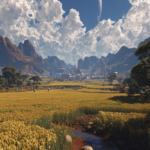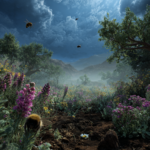
A White Paper on Building Complete Biological Communities,
Weather Systems, Ozone Formation, and the Human Return to Open Air
———————————————
Pollinators, Decomposers, Animal Life, Food Webs,
Emergent Weather, Ozone Shielding, and Humans Outdoors
Abstract
This paper describes the ninth stage of the Mars Habitat Project’s terraforming framework: the development of complete ecosystems on the Martian surface. Stages 7 and 8 established the biological foundation — microbial communities, biocrusts, lichens, mosses, grasses, legumes, trees, and the mycorrhizal networks connecting them. Stage 9 adds the rest. Pollinators arrive: bees, moths, butterflies, and other insects whose movement between flowers enables sexual reproduction in the flowering plants that dominate Stage 8’s grasslands and legume fields. Decomposers arrive: earthworms, soil mites, springtails, beetles, and the vast microbial consortia that break down dead organic matter and return its nutrients to the soil.
Animal life follows: first invertebrates, then small vertebrates, occupying the ecological niches that plant communities have created. Food webs form — not designed by humans, but emergent from the interactions of the species present — and with them the self-regulating dynamics that characterize a living ecosystem. Meanwhile, the physical planet is changing around this biology.
Plant transpiration from expanding vegetated surfaces releases water vapor into the thickening atmosphere, coupling the biological water cycle to the meteorological one. Where enough moisture enters the atmosphere and enough thermal gradients exist, weather patterns begin to develop: clouds, fog, localized precipitation. Atmospheric oxygen, accumulating from decades of compounding photosynthesis and organic carbon burial, reaches concentrations sufficient for ultraviolet photolysis to generate ozone (O₃) in the upper atmosphere.
The forming ozone layer begins absorbing the UVC and UVB radiation that has sterilized the Martian surface for billions of years, reducing surface radiation toward levels that complex life can tolerate without engineered shielding. And humans — who have lived inside enclosed habitats since their arrival — begin spending increasing time outdoors, first in protective suits, then in lighter gear, eventually breathing supplemental oxygen while walking through landscapes that their predecessors planted. This paper describes the introduction of animal life and the formation of food webs, the emergence of weather, the physics of ozone formation, and the moment when humans step outside and stay.
1. Introduction
1.1 What Stage 8 Built
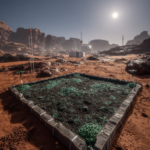
Stage 8 introduced vascular plants to the Martian surface: hardy grasses whose fibrous roots stabilized developing soil, nitrogen-fixing legumes whose Rhizobium symbiosis broke the nitrogen bottleneck, and fast-growing pioneer trees whose deep roots drove soil formation into the regolith at depth. Mycorrhizal networks connected these plants into cooperative communities through underground fungal infrastructure. Oxygen production compounded with every hectare of expanding vegetation. Soil depth increased, centimeter by centimeter, as generations of growth and decay deposited organic matter through the soil profile. The result, in zones where Stage 8 has matured over decades of continuous development, is a vegetated landscape: grass-legume meadows interspersed with stands of pioneer trees, growing in soil that is ten centimeters or more deep, biologically active, nutrient-cycling, and self-maintaining under managed irrigation. It is a landscape. It is not yet an ecosystem.
1.2 What Is Missing
A landscape of plants, fungi, and soil microorganisms is not an ecosystem. It is the producer layer of an ecosystem — the organisms that fix carbon and cycle nutrients. An ecosystem requires consumers, decomposers, and the interactions between them. Stage 8’s plant communities reproduce vegetatively or by wind pollination, but the flowering plants among them — the legumes, many grasses, and the understory herbs that have begun establishing in the shelter of tree canopy — require animal pollinators for sexual reproduction. Without pollinators, these species cannot produce seed, cannot maintain genetic diversity, and cannot colonize new ground beyond the reach of vegetative spread. Stage 8’s dead plant material decomposes through microbial activity, but microbial decomposition alone is slow and incomplete. On Earth, the physical breakdown of leaf litter, dead wood, and root material is performed primarily by invertebrates — earthworms, mites, springtails, millipedes, beetles — that shred, ingest, and fragment organic matter into particles small enough for microbial colonization. Without these animals, litter accumulates, nutrient cycling slows, and the soil ecosystem stagnates. Stage 9 adds the animals. And with the animals comes the complexity — the food webs, the population dynamics, the predator-prey interactions, the competitive and mutualistic relationships — that transforms a managed planting into a self-regulating biological community.
1.3 The Scope of This Paper
This paper addresses four transformations that define Stage 9. First, the introduction of animal life: pollinators, decomposers, and the first vertebrates, and the ecological logic of their sequencing. Second, the emergence of food webs: the self-organizing trophic structures that arise when multiple species interact, and the monitoring systems that track their development. Third, the development of weather: the coupling of biological transpiration and surface hydrology to the thickening atmosphere, producing clouds, fog, and eventually precipitation. Fourth, the formation of the ozone layer and the reduction of surface UV radiation to levels that permit human outdoor activity without full pressure suits. The paper concludes with the criteria for Stage 10 and a discussion of what it means for humans to walk outside on Mars.
2. Pollinators: Enabling Reproduction
2.1 Why Pollination Cannot Be Skipped
Approximately 87 percent of flowering plant species on Earth depend on animal pollination for reproduction. Wind pollination serves grasses and some trees, but the majority of plant diversity — including the legumes that drive the nitrogen economy of Stage 8’s soil — requires an animal vector to move pollen from anther to stigma. Without pollinators, these plants produce no seed. Without seed, they produce no offspring. Without offspring, they cannot spread beyond their current footprint, cannot replace individuals that die, and cannot maintain the genetic variation that enables adaptation to changing conditions. A plant community without pollinators is a community in reproductive decline. It may persist for years or decades through vegetative propagation and long-lived perennial individuals, but it is drawing down a capital of genetic diversity that is not being replenished. Stage 9 introduces pollinators before this decline becomes critical.
2.2 Candidate Pollinators
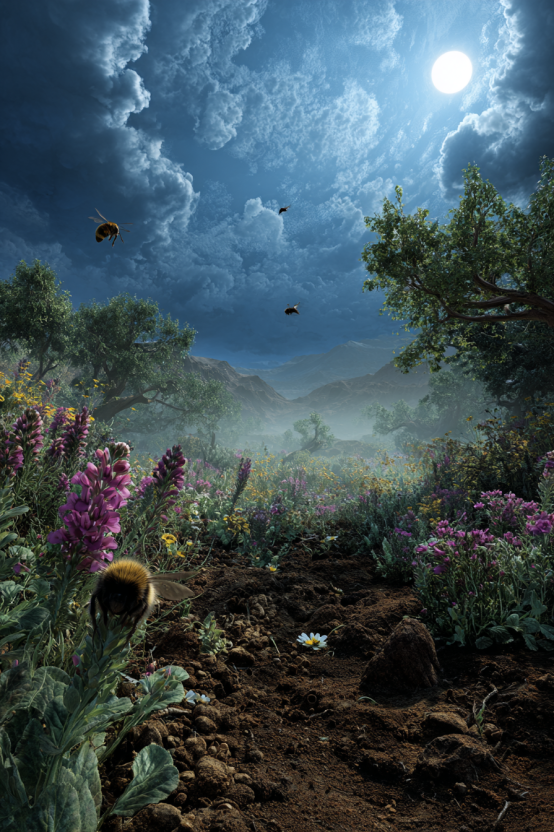
The pollinator species selected for Stage 9 are generalists — species that visit a wide range of flower types rather than specialists tied to a single plant genus. Generalist pollinators provide the broadest reproductive service to the diverse plant community. Bumblebees (Bombus species) are the primary candidates. They are effective pollinators of legumes, wildflowers, and many tree species. They tolerate cold temperatures, forage at lower light levels than honeybees, and can perform buzz pollination — vibrating their flight muscles at the resonant frequency of a flower’s anthers to release pollen that other pollinators cannot access. They nest in the ground, which means they require soil of sufficient depth and structure to excavate burrows — a condition that Stage 8’s soil development must satisfy before bumblebee introduction is possible. Honeybees (Apis mellifera) are introduced as a secondary pollinator: highly efficient, capable of foraging over wide areas, and producing honey that serves as a storable carbohydrate source for the human settlement. Solitary bees (Osmia, Megachile, and related genera) provide pollination in cooler conditions and in habitats too sparse for social bee colonies. Moths and butterflies (Lepidoptera) pollinate flowers that open at dusk or at night and flowers with deep corolla tubes inaccessible to bees. Hoverflies (Syrphidae) pollinate while their larvae feed on decomposing organic matter, serving double duty as pollinators and decomposers.
2.3 The Pollinator Pipeline
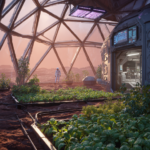
Pollinators are not released into the Martian outdoors as adults caught from greenhouse colonies. They are bred, acclimated, and ecologically tested in the greenhouse nurseries through a pipeline analogous to the plant hardening process of Stage 8. Bumblebee colonies are established in greenhouse enclosures containing the same plant species growing in the outdoor target zones. Colony health is monitored across multiple reproductive cycles to ensure stable population dynamics under Mars-adjusted photoperiod, temperature range, and atmospheric composition. Worker foraging efficiency is measured to confirm that the available flower resources support colony energy balance. Only colonies that demonstrate self-sustaining population dynamics in the greenhouse are selected as source populations for outdoor introduction. The outdoor introduction is staged: initial releases in the most productive and sheltered plant communities, with monitoring of foraging range, nest establishment, and overwinter survival (or equivalent dormancy through Martian cold seasons). Failed introductions are analyzed and retried with modified species, timing, or site selection. Successful populations are allowed to expand naturally into adjacent vegetated zones.
3. Decomposers: Closing the Nutrient Loop
3.1 Why Decomposition Requires Animals
Microorganisms — bacteria and fungi — are the ultimate agents of decomposition: they produce the enzymes that break molecular bonds in cellulose, lignin, chitin, and protein, converting complex organic molecules into mineral nutrients available for plant uptake. But microorganisms work on surfaces. They cannot penetrate intact leaf litter, bark, or woody debris. They colonize the surfaces of organic particles and work inward, and the rate at which they process dead material depends on the surface area available. This is where invertebrate decomposers are essential. Earthworms, soil mites, springtails, millipedes, woodlice, and beetle larvae physically fragment organic matter — chewing, shredding, ingesting, and excreting it as fecal pellets with enormously increased surface area. A leaf that might take years to decompose intact on the soil surface is consumed by earthworms within weeks, passed through the gut where microbial digestion begins, and deposited as worm castings — rich, structured soil aggregates with high nutrient availability. Without invertebrate fragmentation, litter accumulates, nutrients are locked in undecomposed organic matter, and the soil nutrient cycle slows to a fraction of its potential rate.
3.2 Earthworms: Soil Engineers
Earthworms are not merely decomposers. They are soil engineers — organisms whose physical activity restructures the habitat they occupy. Charles Darwin spent decades studying earthworms and concluded that no other animal has played so important a role in the history of the world. Their contributions to soil function are comprehensive. They fragment and ingest organic litter, accelerating decomposition by orders of magnitude. They mix organic matter into the mineral soil through their burrowing activity, producing the intimate blending of organic and mineral material that characterizes healthy topsoil. Their burrows — vertical and horizontal channels through the soil profile — dramatically improve water infiltration, aeration, and root penetration. Their castings are among the most nutrient-rich and structurally stable soil aggregates known, with higher concentrations of available nitrogen, phosphorus, and potassium than the surrounding soil. On Earth, earthworm populations in productive grassland soils process the equivalent of the entire surface soil layer through their guts every few years, continuously mixing, aerating, and enriching the soil. On Mars, earthworms are introduced to Stage 9 zones once soil depth, moisture content, and organic matter levels can support permanent populations. Their introduction represents the activation of the soil’s most powerful biological processing system.
3.3 The Soil Fauna Community
Earthworms are the most visible soil invertebrates, but they operate within a community of organisms spanning multiple size classes. Springtails (Collembola) are among the most abundant soil animals on Earth, feeding on fungal hyphae, decomposing organic matter, and bacterial biofilms. Their grazing stimulates microbial turnover, accelerating nutrient cycling. Soil mites (Acari) include predatory species that regulate springtail and nematode populations, fungivorous species that graze on soil fungi, and detritivorous species that fragment organic matter. Nematodes occupy every trophic level in the soil food web: bacterial feeders, fungal feeders, predators, and plant root feeders. Their populations respond rapidly to changes in soil conditions, making them useful bioindicators of soil health. Beetle larvae (particularly Scarabaeidae and Elateridae) fragment coarse woody debris and incorporate it into the soil. Millipedes and woodlice process leaf litter in surface and near-surface layers. Together, these organisms constitute the soil fauna — the animal community that drives the mechanical phase of decomposition and nutrient cycling. They are introduced in sequence, beginning with the smallest and most stress-tolerant (springtails, mites), followed by earthworms, then larger detritivores, each addition dependent on the presence and stability of the organisms introduced before it.
4. Animal Life and the Emergence of Food Webs
4.1 Trophic Structure
A food web is not designed. It emerges. When multiple species occupy the same habitat, they interact: plants are eaten by herbivores, herbivores are eaten by predators, dead organisms are consumed by decomposers, nutrients released by decomposition are taken up by plants. These interactions create trophic levels — producer, primary consumer, secondary consumer, decomposer — and the energy flows between them define the ecosystem’s metabolic structure. On Earth, food webs are extraordinarily complex: a typical grassland ecosystem involves hundreds of species connected by thousands of feeding relationships, many of them indirect, conditional, or seasonal. On Mars, the initial food webs of Stage 9 will be far simpler — fewer species, fewer connections, more fragile — but they will be real food webs, exhibiting the emergent properties that no amount of human planning can manufacture: population oscillations, competitive exclusion, niche partitioning, keystone effects, and trophic cascades.
4.2 The Introduction Sequence
Animal introduction in Stage 9 follows the same bottom-up logic that has governed every prior stage: each level of the food web is established before the next is introduced. Soil invertebrates come first because they depend only on dead organic matter and microbial communities, both of which are already present from Stages 7 and 8. Pollinators come next because they depend on flowering plants, which are established. Herbivorous insects — caterpillars, grasshoppers, aphids — follow, because they depend on plant biomass that is now abundant enough to sustain consumer populations without being destroyed by overgrazing. Predatory insects and spiders follow the herbivores, because they depend on prey populations that are now large enough to support predator populations. Small insectivorous vertebrates — initially amphibians and small reptiles adapted to cool conditions, eventually birds — follow the insects, because they depend on invertebrate prey populations that are now diverse and abundant.
Each introduction is a deliberate ecological act, informed by the specific conditions of the target zone and the trophic structure already present. No herbivore is introduced until the plant community can absorb grazing pressure without collapse. No predator is introduced until prey populations are self-sustaining. No vertebrate is introduced until the invertebrate food base is diverse enough to support vertebrate energy requirements. The pace is measured in years per trophic level. The greenhouse nurseries maintain breeding populations of every animal species in the introduction pipeline, ensuring that multiple cohorts are available for outdoor release and that genetic diversity is maintained regardless of outdoor survival rates. Failed introductions — species that cannot maintain populations outdoors — are replaced by alternatives from the nursery’s genetic stocks. Successful introductions are allowed to reproduce and disperse naturally, with population monitoring to detect collapses, outbreaks, or other dynamics requiring management intervention.
4.3 Self-Regulation and Emergent Stability
The goal of Stage 9 is not to maintain a curated collection of species. The goal is to establish a community that regulates itself. On Earth, ecosystems achieve dynamic stability through the interactions of their component species: predators suppress herbivore populations before they overgraze the vegetation; decomposers recycle nutrients before they accumulate in unprocessed litter; competitive interactions between species prevent any single species from monopolizing resources. This stability is not static — populations fluctuate, species composition shifts with seasons and years, disturbances periodically reset local communities — but it is resilient, returning to functional equilibrium after perturbation without human intervention. Stage 9’s managed ecosystem will not achieve this full resilience for decades or longer. In the early phases, human management compensates for the missing interactions: culling herbivore populations that outstrip their food supply, supplementing decomposer communities that cannot keep pace with litter production, reintroducing predators whose populations crash. Over time, as species diversity increases, as trophic connections multiply, and as the food web develops the redundancy and complexity that confer resilience, the need for human management diminishes. The ecosystem begins to run itself. That transition — from managed biology to self-regulating ecology — is the defining achievement of Stage 9.
5. The Emergence of Weather
5.1 Transpiration and Atmospheric Moisture
Every plant on the Martian surface is a water pump. Roots draw water from the soil, stems transport it upward through the xylem, and leaves release it into the atmosphere through stomatal transpiration. On Earth, terrestrial vegetation transpires approximately 60,000 cubic kilometers of water per year — roughly ten percent of all atmospheric moisture. Forests create their own rainfall: moisture transpired from canopy foliage rises, condenses, and falls as precipitation downwind, watering landscapes hundreds of kilometers from the transpiration source. This biological water cycle is a major driver of terrestrial weather patterns, and its absence from Mars is one reason why the Martian atmosphere, despite containing water vapor, produces almost no precipitation.
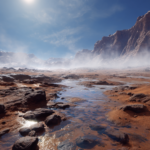
Stage 9’s expanding vegetation begins coupling the biological water cycle to the Martian atmosphere. Each hectare of transpiring plant canopy adds water vapor to the near-surface air. In the early phases, the quantity is minuscule relative to the atmospheric volume, and the moisture evaporates into the thin, dry air without condensing. But as vegetated area expands across hundreds and then thousands of hectares, and as Stage 4’s atmospheric thickening raises surface pressure and reduces the rate at which moisture diffuses upward and disperses, the humidity in the boundary layer above vegetated regions begins to rise measurably. Temperature inversions — layers of warmer air over cooler surface air, common in early morning on Mars as on Earth — trap this moisture near the surface. The first visible consequence is fog: water vapor condensing in cool, humid air above vegetated lowlands at dawn. Fog is not rain. But fog is water delivered from the atmosphere to the surface without irrigation infrastructure, and for biocrusts, lichens, mosses, and shallow-rooted plants, fog moisture can be a significant water source. The appearance of regular fog in vegetated zones is the first meteorological signature of a biologically active surface.
5.2 Clouds and Precipitation
Clouds form when moisture-laden air rises, cools to its dew point, and water vapor condenses onto nucleation particles — dust, salt crystals, organic aerosols. Mars has abundant dust nucleation particles. What it has lacked is sufficient atmospheric moisture and sufficient atmospheric mass to sustain the convective or orographic lifting that drives cloud formation on Earth. As Stage 4’s atmospheric pressure increases and Stage 9’s biological transpiration adds moisture, the conditions for cloud formation improve. Thermal convection over sun-warmed vegetated surfaces — which absorb more solar radiation than bare regolith because of their lower albedo — lifts moist boundary-layer air upward. If the atmospheric column is deep enough and moist enough, condensation occurs and clouds form. Initially, these will be thin, transient, low-altitude clouds that form in the late morning over the most productive vegetated zones and dissipate by afternoon. Over time, as atmospheric mass and moisture increase, clouds become more frequent, more persistent, and higher in altitude.
Precipitation — water falling from clouds to the surface as rain, snow, or frost — requires clouds with sufficient liquid water content and droplets large enough to overcome updraft and fall. On present-day Mars, the atmosphere is too thin and too dry for precipitation except as CO₂ frost and rare water ice crystals. As atmospheric conditions evolve through Stages 4 and 9, the threshold for liquid or frozen water precipitation is gradually approached. The first precipitation events will likely be light frost or snow in cold, low-lying areas where moisture from biological transpiration has accumulated to locally high concentrations. Eventually, as the hydrological cycle matures, rain becomes possible — initially in quantities too small to measure by most instruments, growing over decades and centuries toward quantities that are ecologically meaningful. The first rain that falls on Martian soil and is absorbed by plant roots that transpire it back into the atmosphere to fall again represents the closure of the planetary water cycle — the moment when the hydrological system becomes, like the ecological system, self-sustaining.
5.3 Weather as a System Property
Weather is not something that is introduced. It is a system property that emerges from the interaction of atmospheric mass, solar energy, surface characteristics, and moisture. Stage 4 provides atmospheric mass. The sun provides energy. Stages 7, 8, and 9 provide the surface characteristics — vegetation, transpiration, altered albedo, surface roughness — that modulate how solar energy is absorbed, redistributed, and released. Stage 5 provides the water. When these components reach sufficient scale and interact with sufficient intensity, weather patterns emerge: diurnal temperature cycling drives thermal circulation; differential heating between vegetated and bare surfaces creates local pressure gradients and winds; moisture transport from wet to dry areas drives fog and cloud formation; seasonal variation in solar angle drives seasonal weather patterns. None of this is engineered. It is emergent. The human role is to create the conditions — atmospheric mass, surface water, vegetation — and the physics does the rest. The emergence of weather on Mars is the emergence of a planetary system that is no longer purely geological and atmospheric but also biological: a system where life influences climate and climate influences life, the same coupled system that operates on Earth and on no other known world.
6. The Ozone Layer: A Shield from Biology
6.1 How Ozone Forms
Ozone (O₃) forms in an atmosphere through a process that requires only two things: molecular oxygen (O₂) and ultraviolet radiation. UV photons with wavelengths below 240 nanometers split O₂ molecules into individual oxygen atoms. These atoms then react with intact O₂ molecules to form O₃. This is the Chapman cycle, first described in 1930, and it is the process that created Earth’s ozone layer beginning after the Great Oxidation Event. On Earth, the ozone layer resides in the stratosphere at altitudes of 15 to 35 kilometers, where it absorbs the majority of incoming UVB (280–315 nm) and virtually all UVC (100–280 nm) radiation. UVC is the most biologically destructive wavelength range — it damages DNA directly, denatures proteins, and is lethal to most unshielded organisms. UVB causes sunburn, DNA mutations, and skin cancer but is partially tolerable at the levels that penetrate Earth’s ozone layer. The ozone layer is the reason complex life exists on land surfaces on Earth. Before the ozone layer formed, life was confined to water (which absorbs UV) and to rock interiors (endolithic habitats). The ozone shield opened the land surface to colonization.
6.2 Ozone on Mars
Present-day Mars has a trace ozone layer produced by the photolysis of CO₂ and water vapor, but it is vanishingly thin — roughly one-thousandth the column density of Earth’s ozone layer. It provides no meaningful UV protection. The Martian surface receives the full spectrum of solar UV including UVC, which is why surface UV doses on Mars cause DNA damage at approximately 900 times the rate on Earth’s surface. The organisms deployed in Stages 6 through 8 survive this radiation through evolved UV-screening pigments (scytonemin, mycosporine-like amino acids), DNA repair mechanisms, physical shielding (burial in soil, lichen thalli, biocrust matrix), and the progressive UV attenuation provided by Stage 4’s thickening atmosphere. But these are survival strategies, not comfort. Complex multicellular organisms — animals, large plants, and especially humans — cannot thrive under Mars-level UV indefinitely. A real ozone layer is required.
6.3 The Oxygen Threshold for Ozone
Ozone formation scales with atmospheric O₂ concentration. Modeling of early Earth’s atmosphere suggests that meaningful UV shielding — sufficient to reduce surface UVB to levels tolerable by unshielded land organisms — requires atmospheric O₂ concentrations of approximately one to ten percent of present Earth levels, or roughly 0.2 to 2 percent by volume. Below this range, the ozone column is too thin to absorb significant UVB. Above it, the ozone layer thickens rapidly with increasing O₂, providing progressively better protection. The exact threshold on Mars depends on the atmospheric pressure (which determines the total column mass of O₂ available for ozone production), the UV flux (which drives the Chapman cycle), and the concentration of ozone-destroying catalysts (chlorine, nitrogen oxides, hydrogen radicals) in the Martian atmosphere.
Stage 8’s compounding photosynthetic oxygen production, combined with organic carbon burial in deepening soils, gradually increases atmospheric O₂ concentration. The timeline to reach the one-percent threshold depends on the total vegetated area, the net primary productivity of that vegetation, the fraction of fixed carbon buried rather than decomposed, and the total atmospheric mass (which determines what one percent represents in absolute terms). Estimates span decades to centuries, depending on the rate of biological expansion. What is certain is the direction: every year, the atmospheric O₂ concentration is higher than the year before, and the ozone column density increases accordingly. At some point — not predictable to the year, but predictable in kind — the ozone layer reaches a thickness that measurably reduces surface UV. That moment is a threshold event for habitability. It is the moment when the biology that produced the oxygen begins to be protected by the oxygen it produced. The shield is built by the organisms it shields. This is the same feedback loop that operated on Earth after the GOE, and it is the feedback loop that will eventually make the Martian surface habitable without engineered UV protection.
7. Humans Step Outside
7.1 The History of Enclosure
Since their arrival on Mars, humans have lived inside: inside habitats, inside greenhouses, inside pressure suits when venturing onto the surface. Every breath has been filtered, pressurized, and oxygen-enriched. Every exposure to the surface has been limited by suit endurance, radiation dosimetry, and the sheer physiological burden of working in a pressure differential environment. The Martian surface has been a workplace, not a habitat. Humans have gone outside to perform tasks and returned inside to live. This is the condition of every human who has ever set foot on another world — the Apollo astronauts, the crews of the International Space Station, and every Martian settler from Stage 2 onward. Stage 9 is where that condition begins to change.
7.2 The Transition to Open-Air Activity
The transition from enclosed to outdoor existence is not a single threshold crossed on a single day. It is a gradient, traversed over years, as atmospheric conditions improve incrementally. The milestones along this gradient are defined by atmospheric pressure, oxygen partial pressure, temperature, and UV exposure. When atmospheric pressure exceeds approximately 100 millibars (10 percent of Earth sea level), the physiological risk of acute decompression drops dramatically, and pressure suit requirements can be relaxed to lighter, more flexible garments. When oxygen partial pressure exceeds approximately 60 millibars — roughly 30 percent of Earth’s sea-level O₂ partial pressure — sustained human activity is possible with supplemental oxygen delivered by lightweight mask rather than full pressure helmet. When the ozone layer has developed sufficiently to reduce surface UV below the threshold for acute erythema (sunburn) during typical outdoor exposure durations, full UV-protective garments are no longer required. When surface temperatures in vegetated zones remain above minus 20 degrees Celsius for significant portions of the Martian day during the warm season — a condition that Stage 4’s atmospheric warming and the local microclimate effect of vegetation canopy make increasingly likely — outdoor activity is limited by cold tolerance, not by survival.
Each of these milestones is approached asymptotically, not achieved overnight. Early outdoor activity in Stage 9 involves humans in reduced-weight pressure suits spending hours rather than minutes in the most sheltered, warmest, most atmospherically favorable zones — low-elevation vegetated areas where atmospheric pressure is highest, where canopy cover moderates temperature, where the biological moisture cycle humidifies the air, and where the developing ozone layer provides partial UV protection. As conditions improve, suit weight decreases, exposure duration increases, and the range of outdoor habitable zones expands. The eventual goal — likely achieved fully only in Stage 11 or 12 — is a human walking in the open air on Mars wearing nothing more protective than warm clothing and sunscreen, breathing an atmosphere with enough oxygen to sustain moderate exertion. Stage 9 does not reach that goal. Stage 9 begins the walk toward it.
7.3 The Psychological Dimension
The significance of humans outdoors on Mars extends beyond physiology. Humans are not evolved for enclosed spaces. The stress of confinement, the absence of natural light cycles, the sensory monotony of habitat interiors, and the psychological weight of knowing that the only thing between survival and death is an engineered wall — these factors have affected every crew that has ever lived in space or in isolated analog environments. The ability to step outside, to feel wind (however thin), to see a horizon of green rather than red, to walk on ground that is soft with soil rather than hard with regolith, to hear insects (however faintly in the thin air) — these are not luxuries. They are biological needs of a species that evolved outdoors on a living planet. Stage 9’s outdoor environments, even while they remain hostile by terrestrial standards, offer something that no habitat interior can replicate: the experience of being outside, on a world that is coming alive, in a landscape that humans helped create. The psychological benefit of this experience — the relief of enclosure stress, the restoration of agency and connection to the natural environment, the tangible daily evidence that the planetary transformation is working — may be as important to the long-term success of the settlement as any tonnage of oxygen or centimeter of soil.
8. Continuity with All Prior Stages
Stage 9 is the culmination of everything the framework has built, and every prior stage remains actively operational. Stage 1’s instruments now monitor not only geological and atmospheric conditions but also ecological parameters: species inventories, population counts, food web structure, weather events, ozone column density. Stage 2’s shielding continues protecting the core settlement from major solar events. Stage 3’s greenhouses operate as nurseries at maximum capacity, breeding and acclimating every animal and plant species in the introduction pipeline while continuing food production. Stage 4’s atmospheric engineering continues, now measurably assisted by biological oxygen production and biological moisture cycling. Stage 5’s water systems continue supplying irrigation and expanding the surface hydrology that feeds the emerging weather cycle. Stage 6’s original test zones, now decades old, serve as the most mature ecological reference sites on the planet. Stage 7’s biocrusts and microbial communities continue operating across the landscape, maintaining soil stability and nutrient cycling in zones not yet advanced to vascular plant cover. Stage 8’s plant communities continue expanding and maturing, their root systems deepening the soil, their transpiration feeding the atmospheric moisture, their photosynthesis feeding the oxygen budget.
The interactions between stages are now so densely interwoven that separating them is artificial. The ozone layer forming from biological oxygen shields the biology that produces the oxygen. The weather forming from biological transpiration waters the biology that transpires. The soil building from plant root activity supports the plants whose roots build it. The food webs regulating herbivore populations protect the plants that feed the herbivores. Every element of the system supports every other element. The framework has become, in the most literal sense, an ecology: a system of interdependent relationships that sustains itself through its own internal dynamics. The human role is shifting from builder to steward — from creating the components to managing the system they compose, intervening when necessary, observing when not, and trusting the biological processes that have governed living planets for four billion years to do what they have always done: persist, adapt, and build.
9. Criteria for Advancing to Stage 10
Stage 10 — Climate Stabilization and Atmospheric Maturation — begins when the coupled biological-atmospheric system of Stage 9 demonstrates self-sustaining dynamics at regional scale. The specific criteria are as follows. At least one contiguous vegetated region exceeding 100 square kilometers must demonstrate a self-regulating ecosystem with measurable food web dynamics: producer, consumer, and decomposer trophic levels all present, population fluctuations within natural bounds without human intervention for at least five consecutive Martian years. The atmospheric ozone column density must be sufficient to reduce surface UVB flux below 10 times Earth’s equatorial surface level, as measured by continuous monitoring at multiple locations. Atmospheric oxygen concentration must exceed 0.5 percent by volume and must demonstrate a positive annual trend sustained over at least ten consecutive Martian years, confirming that biological oxygen production exceeds all atmospheric and surface sinks. Meteorological events — fog, cloud formation, frost, or precipitation — attributable to biological transpiration must occur regularly (at least seasonal frequency) in at least one vegetated region, confirmed by atmospheric monitoring. Human outdoor activity in the most favorable zones must be sustainable for periods exceeding four continuous hours with lightweight supplemental equipment (oxygen mask, thermal garments, UV-protective outer layer), demonstrated by routine operational experience over at least two Martian years.
These criteria confirm that the planetary transformation has crossed a threshold: from a system that requires continuous human engineering to maintain, to a system that generates its own momentum. The atmosphere is gaining oxygen. The ozone layer is thickening. The weather is cycling moisture. The ecosystems are self-regulating. Humans are outside. The planet is no longer being terraformed in the sense of imposed transformation. It is terraforming itself, through the biological and physical feedback loops that the framework set in motion. Stage 10 addresses the management and stabilization of that momentum toward long-term habitability.
10. Discussion
Stage 9 is the stage where the Mars Habitat Project encounters its deepest uncertainty and its greatest reward. The uncertainty is ecological: food webs are emergent systems, and emergent systems cannot be fully predicted from their components. The interactions between hundreds of species across multiple trophic levels produce dynamics — oscillations, cascades, regime shifts — that are qualitatively different from the behavior of any individual species. The history of ecology on Earth is a history of surprises: keystone species whose removal collapsed entire communities, invasive species that restructured food webs in decades, trophic cascades that propagated from top predators down to soil chemistry. On Mars, where every species has been deliberately introduced by humans, the food web will still produce surprises. Species will interact in ways that were not anticipated. Populations will boom and crash. Some introductions will fail catastrophically. Others will succeed beyond all expectation. The role of the ecological managers is not to prevent surprises but to detect them, interpret them, and respond adaptively. The ecosystem will teach its managers how it works, and the managers must be willing to learn.
The reward is equally profound. Stage 9 is the stage where Mars stops being a construction project and starts being a world. A world has weather. A world has animals. A world has the sound of wind in trees and the sight of clouds on the horizon and the feel of soil under foot. A world has the smell of rain — petrichor, the scent of geosmin released by soil bacteria when water hits dry ground, a smell that humans find instinctively pleasant because it signals biological activity and water availability. When petrichor rises from Martian soil after the first rain falls on a biologically active surface, it will be the smell of a planet coming alive. No instrument can measure what that moment means. But every human who walks outside and smells it will know.
11. Conclusion
Stage 9 of the Mars Habitat Project builds complete ecosystems on the Martian surface. Pollinators enable the sexual reproduction of flowering plants, maintaining genetic diversity and enabling colonization of new ground. Decomposers — earthworms, soil mites, springtails, beetles, and their microbial partners — close the nutrient loop by fragmenting and processing dead organic matter, returning its mineral nutrients to the soil for plant uptake. Animal life occupies the trophic levels above the producer base: herbivores, predators, parasites, and the emergent food webs that connect them into self-regulating communities. Weather patterns develop as plant transpiration couples the biological water cycle to the thickening atmosphere, producing fog, clouds, and eventually precipitation. Atmospheric oxygen from decades of compounding photosynthesis reaches concentrations sufficient for UV photolysis to generate a measurable ozone layer, which begins absorbing the UVB and UVC radiation that has sterilized the Martian surface since the planet lost its own atmospheric protection billions of years ago. And humans — the species that initiated this entire chain of events — begin stepping outside their enclosed habitats into a world they can see changing around them.
The Martian surface in Stage 9 is not Earth. It is cold, thin-aired, UV-bright, and hostile by any terrestrial standard. But it is alive. It has soil with worms in it. It has flowers with bees on them. It has trees with birds in them. It has clouds that form from water that plants pulled from the ground and released into the sky. It has an ozone layer being built, molecule by molecule, from oxygen that cyanobacteria and grasses and trees pulled from carbon dioxide one photon at a time. It is a world in the earliest stages of becoming habitable, driven by the same biology that made Earth habitable, applied with human intention to a planet that was waiting for it. The next stages describe the maturation of that world: climate stabilization, atmospheric completion, and the eventual emergence of a self-sustaining biosphere. But the living foundation of that biosphere is built here, in Stage 9, in the first food web, the first weather, the first ozone, and the first human footprint in Martian soil that is soft enough to hold one.
References
Chapman, S. (1930). A theory of upper atmospheric ozone. Memoirs of the Royal Meteorological Society, 3(26), 103–125.
Darwin, C. (1881). The Formation of Vegetable Mould Through the Action of Worms. John Murray, London.
Edwards, C.A. & Bohlen, P.J. (1996). Biology and Ecology of Earthworms, 3rd ed. Chapman & Hall.
Goldblatt, C. et al. (2006). Bistability of atmospheric oxygen and the Great Oxidation. Nature, 443, 683–686.
Kasting, J.F. (1987). Theoretical constraints on oxygen and carbon dioxide concentrations in the Precambrian atmosphere. Precambrian Research, 34, 205–229.
Lavelle, P. et al. (2006). Soil invertebrates and ecosystem services. European Journal of Soil Biology, 42, S3–S15.
Makarieva, A.M. & Gorshkov, V.G. (2007). Biotic pump of atmospheric moisture as driver of the hydrological cycle on land. Hydrology and Earth System Sciences, 11, 1013–1033.
Ollerton, J. et al. (2011). How many flowering plants are pollinated by animals? Oikos, 120, 321–326.
Paine, R.T. (1966). Food web complexity and species diversity. The American Naturalist, 100, 65–75.
Segura, A. et al. (2003). Ozone concentrations and ultraviolet fluxes on Earth-like planets around other stars. Astrobiology, 3(4), 689–708.
Smith, S.E. & Read, D.J. (2008). Mycorrhizal Symbiosis, 3rd ed. Academic Press.
Wall, D.H. et al. (2012). Soil Ecology and Ecosystem Services. Oxford University Press.