Why Mars Lost Its Shield, What Science Proposes to Replace It,
and How an Artificial Magnetosphere Could Be Constructed
Abstract
This white paper examines the second stage of the Mars Habitat Project’s ten-stage terraforming framework: the restoration of planetary magnetic shielding. Mars lost its internally generated magnetic field approximately four billion years ago when its core dynamo ceased. Without this protective magnetosphere, the solar wind has continuously stripped the Martian atmosphere, reducing surface pressure to less than 1% of Earth’s and rendering the planet uninhabitable at the surface.
This paper argues that any effort to thicken the Martian atmosphere — the central objective of stages four and five of the framework — is futile without first solving the problem of atmospheric retention. Building an atmosphere only to have it stripped away is not terraforming; it is filling a bathtub with no plug.
The thesis reviews the physics of why Mars lost its field, evaluates four proposed engineering approaches to creating an artificial magnetosphere (the L1 Lagrange Point dipole, the equatorial superconducting loop, the Phobos plasma torus, and the localized surface shield), and advances hypotheses for how the most promising approaches could be pursued with foreseeable technology. As with all stages of this framework, this thesis operates within a “could do” paradigm, presenting what science suggests is possible without asserting that it will occur.
1. Introduction
1.1 The Problem Before All Other Problems
There is a logical sequence to making a planet habitable, and it begins with a question that precedes every other: can this planet hold an atmosphere? If the answer is no, then every subsequent investment — in atmospheric engineering, water liberation, biological introduction, greenhouse construction, human settlement — is built on a foundation that actively erodes.
Mars cannot currently hold a thick atmosphere. Not because it lacks the mass or gravity to do so (Mars at 38% of Earth’s gravity could theoretically retain a substantially thicker atmosphere than it currently possesses), but because the solar wind, unimpeded by any global magnetic field, strips atmospheric particles from the upper atmosphere at a rate that MAVEN has measured at approximately 100 grams per second under normal solar conditions, spiking dramatically during coronal mass ejections.
This is not a minor leakage. Over geological timescales, it has transformed Mars from a planet with a multi-bar atmosphere, liquid water oceans, and potentially habitable surface conditions into the cold, desiccated, radiation-blasted world we observe today. The atmosphere that once existed is gone. If a new atmosphere is to be built, the mechanism that destroyed the old one must be addressed first.
Stage 2 of the Mars Habitat Project framework is therefore not an optional enhancement. It is a prerequisite. It runs concurrently with Stage 1 (Robotic Reconnaissance) because the data required to design a magnetic shielding solution overlaps significantly with the broader reconnaissance objectives. But it must be operational before Stage 4 (Atmospheric Engineering) can meaningfully begin.
1.2 Scope and Structure
This paper is organized in five sections. First, a review of how and why Mars lost its magnetic field and what the consequences have been. Second, a survey of what natural magnetic resources Mars still possesses in the form of crustal magnetic anomalies. Third, a comprehensive evaluation of four proposed engineering approaches to creating an artificial magnetosphere, drawing on peer-reviewed literature through 2025. Fourth, hypotheses regarding which approaches could be most effectively pursued and what prerequisites must be met. Fifth, a discussion of how magnetic shielding integrates with the broader ten-stage framework and what it enables for downstream stages.
2. How Mars Lost Its Magnetic Field
2.1 The Dynamo That Died
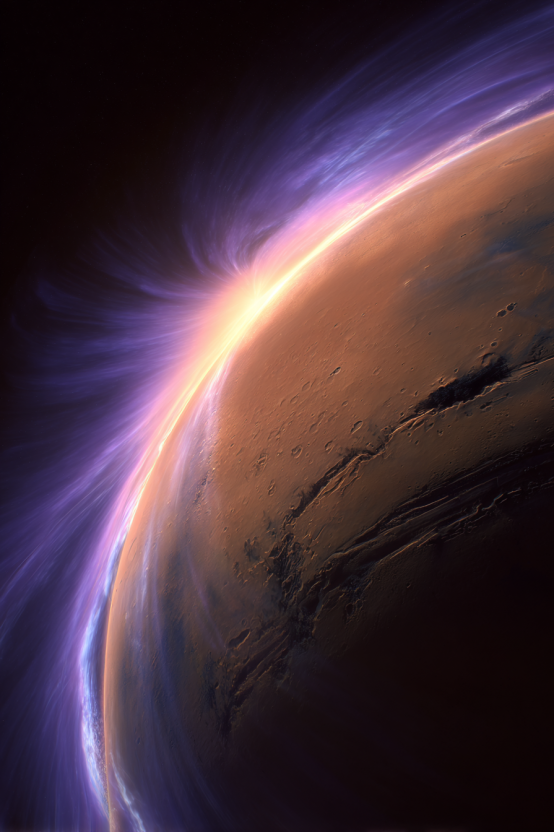
Earth’s magnetic field is generated by a dynamo process: the convection of electrically conductive liquid iron alloys in the outer core, driven by heat escaping from the inner core and the planet’s interior. This convection, combined with the planet’s rotation, generates self-sustaining electric currents that produce a dipolar magnetic field extending tens of thousands of kilometers into space. This magnetosphere deflects the charged particles of the solar wind around the planet, protecting both the atmosphere and the surface from radiation.
Mars once had such a field. Paleomagnetic evidence preserved in the Martian crust — particularly the intense crustal magnetic anomalies mapped by Mars Global Surveyor in the southern highlands — demonstrates that a strong global magnetic field existed during the Noachian period, the era when Mars’s surface was most Earth-like. InSight’s seismological measurements confirmed that Mars has a liquid iron-alloy core approximately 1,830 kilometers in radius, larger and less dense than previously estimated, suggesting the presence of significant lighter elements such as sulfur mixed with the iron and nickel.
However, Mars is smaller than Earth. Its core cooled more rapidly. Without sufficient internal heat to sustain vigorous convection, the dynamo weakened and eventually ceased. The timing remains debated, but current evidence suggests the global field declined significantly by approximately 4 billion years ago, with possible intermittent or weakened activity persisting for some time afterward. The cessation was not instantaneous but the result was permanent: Mars has not generated a global magnetic field for billions of years, and without artificial intervention, it will not do so again.
2.2 The Consequences: Atmospheric Stripping
Once the magnetic shield collapsed, the solar wind — a stream of charged particles (primarily protons and electrons) flowing outward from the Sun at 400 to 800 kilometers per second — gained direct access to the upper Martian atmosphere. The interaction between the solar wind and the unshielded atmosphere drives several loss mechanisms: sputtering (solar wind ions impacting atmospheric molecules and ejecting them), ion pickup (atmospheric ions accelerated by the solar wind’s electric field and swept away), and photochemical escape (solar ultraviolet radiation ionizing atmospheric molecules which then escape along the magnetic field of the solar wind).
NASA’s MAVEN orbiter, operating since 2014, has provided the most detailed measurements of these processes. MAVEN confirmed that atmospheric loss rates increase by an order of magnitude or more during solar storms and coronal mass ejections. Over billions of years, this process has reduced the Martian atmosphere from what scientists estimate was several hundred millibars (potentially exceeding one bar) to today’s 6.1 millibars. The loss is ongoing. Even the atmosphere Mars has today continues to erode, balanced only partially by outgassing from the interior and sublimation from the polar caps.
The implications for terraforming are direct and unambiguous. Any atmospheric engineering effort that adds gas to the Martian atmosphere without addressing the solar wind stripping mechanism is working against a process that has been operating for four billion years. The added atmosphere will be stripped on geological timescales. While those timescales are long by human standards (tens to hundreds of millions of years for significant loss), the investment required to build an atmosphere is so enormous that allowing preventable loss is an unacceptable waste of resources. The plug must be installed before the tub is filled.
2.3 The Radiation Consequence
The loss of the magnetic field carries a second consequence beyond atmospheric stripping: radiation exposure. Without a magnetosphere, the Martian surface is bombarded by galactic cosmic rays (primarily high-energy protons and alpha particles originating outside the solar system) and solar energetic particles (accelerated by solar flares and coronal mass ejections). Curiosity’s Radiation Assessment Detector measured an average surface dose rate of approximately 0.67 millisieverts per day — roughly 200 times the average surface radiation on Earth. Over a calendar year, a person standing unshielded on the Martian surface would accumulate approximately 245 millisieverts, well above the 20 millisieverts per year recommended limit for radiation workers on Earth and sufficient to significantly elevate cancer risk over a multi-year stay.
For enclosed habitats and greenhouses (Stage 3), radiation can be managed through physical shielding: regolith cover, water barriers, or structural materials. But for the open-air biological colonization that is the ultimate objective of terraforming (Stages 6 through 10), a magnetic field is required. Organisms introduced to the open Martian surface must survive radiation levels that would sterilize most known terrestrial life forms. A restored or artificial magnetosphere, combined with a thickened atmosphere (which itself provides additional radiation shielding), is the only pathway to surface conditions compatible with unprotected biological activity.
3. What Mars Still Has: Crustal Magnetic Anomalies
Although Mars lacks a global magnetic field, it is not entirely unmagnetized. Mars Global Surveyor’s magnetometer mapped intense, localized crustal magnetic anomalies — regions where ancient magnetized rock in the crust produces magnetic fields far stronger than the planet’s negligible global average. These anomalies are concentrated primarily in the southern highlands, particularly in the Terra Sirenum and Terra Cimmeria regions, and some are powerful enough to form localized “mini-magnetospheres” that measurably stand off the solar wind and partially deflect charged particles.
Research on these anomalies has direct habitability implications. A 2018 study by Emoto and Takao simulated the trajectories of energetic protons interacting with Martian crustal magnetic anomalies and found that protons approaching from the west could be completely eliminated by the anomaly’s field, while those from the east were concentrated between the magnetic poles. A UCL thesis by Rabiee investigated the use of crustal fields as radiation shielding for extravehicular activity, estimating that within regions of 14 nanotesla field strength (measured at 400 km altitude), allowable extravehicular time could range from approximately 34 seconds to 74 minutes per day, depending on the solar cycle and specific location — modest but meaningful reductions in radiation exposure compared to unshielded areas.
The existence of crustal anomalies does not solve the global magnetic shielding problem. They are localized, fixed in place, and provide only partial protection. However, they represent a natural resource that could inform site selection for early habitation (Stage 3) and outdoor biological test zones (Stage 6). If regions with strong crustal fields correlate with accessible subsurface water ice and favorable terrain — a question that Stage 1 reconnaissance must answer — they could represent optimal locations for the earliest phases of human settlement, leveraging natural shielding to supplement whatever artificial system is deployed at the global scale.
4. Proposed Engineering Approaches
Four distinct engineering approaches to creating an artificial Martian magnetosphere have been proposed in the peer-reviewed literature. Each addresses the same fundamental problem — generating a magnetic field of sufficient strength and spatial extent to deflect the solar wind from the planet — but from radically different engineering perspectives. This section evaluates each approach on its physical principles, feasibility, resource requirements, and alignment with the “could do” framework of this thesis.
4.1 Approach One: The L1 Lagrange Point Magnetic Dipole
4.1.1 The Concept
In 2017, Dr. Jim Green, then Director of NASA’s Planetary Science Division, presented a concept at the Planetary Science Vision 2050 Workshop proposing that an artificial magnetic dipole be positioned at the Mars–Sun L1 Lagrange Point — the gravitationally stable location between Mars and the Sun where their gravitational pulls roughly balance. A magnetic shield at this position would intercept the solar wind before it reaches Mars, placing the planet within the protected magnetotail of the artificial field, analogous to how Earth’s magnetosphere creates a shielded wake downstream from the Sun.
Green’s team ran magnetohydrodynamic simulations showing that a dipole field at L1, generating field strengths comparable to Earth’s at the magnetopause boundary, could effectively counteract the solar wind. Their models predicted that if atmospheric stripping were halted, Mars’s atmosphere would naturally thicken over time through continued outgassing, eventually increasing surface pressure and raising the average global temperature by approximately 4°C — enough to begin melting polar CO₂ ice and triggering a positive feedback greenhouse effect. Green suggested that inflatable structures generating magnetic fields of 1 to 2 Tesla could serve as the active shield element.
4.1.2 The Physics Challenge
Subsequent analysis has revealed fundamental physical constraints that make the “compact dipole at L1” approach far more difficult than the original proposal suggested. A rigorous 2020 study published in the International Journal of Astrobiology by Fang and colleagues demonstrated a counterintuitive result: the amount of superconducting material required for a magnetic shield is inversely proportional to the cube of the loop radius. That is, making the magnet smaller requires exponentially more material, not less.
The mathematics are severe. If one attempted to build a compact solenoid (loop radius and wire radius both approximately 10 km) and place it at L1, the superconductor would need to generate a critical magnetic field of approximately 200 Tesla, and the total mass of superconducting material would be on the order of 10¹ grams (10 trillion metric tons). Extracting the necessary rare elements (bismuth for BSCCO-type superconductors) would require processing approximately 10²⁵ grams of Martian rock — roughly 10% of the planet’s entire mass. This is clearly not feasible.
If one instead attempted to fit the superconductor inside a rocket fairing (a volume of approximately 1,000 cubic meters, consistent with SpaceX Starship’s payload capacity) and transport it from Earth, the required critical magnetic field would be approximately 10¹¹ Tesla — a magnetar-level field whose energy density exceeds the bulk modulus of any known solid material. This approach is physically impossible with any foreseeable technology.
4.1.3 Assessment
The L1 dipole concept is elegant in principle and the original simulations confirmed that the physics of solar wind deflection via an artificial magnetosphere are sound. However, the engineering reality of building and positioning a sufficiently powerful compact magnet at L1 appears to be beyond foreseeable technology. The concept’s greatest contribution may be the simulation framework itself, which validated that an artificial magnetosphere could protect Mars. The question is where and how to generate the field.
4.2 Approach Two: The Equatorial Superconducting Loop
4.2.1 The Concept
The same 2020 study that identified the limitations of the compact L1 approach also proposed the most physically feasible alternative: rather than concentrating the magnetic field in a small device, distribute it over the largest possible loop radius. A superconducting wire encircling Mars at the equator (loop radius of approximately 3,400 km) would minimize the required superconductor mass due to the inverse-cube relationship between loop radius and material requirements.
With a Mars-sized loop, the wire diameter could be as small as 5 centimeters, and the total mass of superconducting material would be approximately 10¹² grams (one billion metric tons). If constructed from BSCCO (a bismuth-based high-temperature superconductor), the bismuth required could be extracted by mining only 0.1% of Olympus Mons. If constructed from carbon nanotube superconductors — which use the far more abundant element carbon — the required mining would be only 10⁻¹⁰ of Olympus Mons, an almost negligible fraction.
4.2.2 Engineering Challenges
The equatorial loop is physically feasible in terms of material requirements but presents extraordinary engineering challenges. A 20,000-kilometer superconducting wire must be manufactured (current BSCCO production achieves kilometer-length segments). The wire must be routed around Mars’s equator, crossing the Tharsis volcanic province including the flanks of Olympus Mons — the tallest mountain in the solar system. The wire must be continuously insulated and maintained at superconducting temperatures (below approximately 93 Kelvin for YBCO, approximately 5 Kelvin for carbon nanotube superconductors). A vacuum insulation sheath would need to accompany the wire around the entire equator.
The wire cannot be manufactured on Earth and transported. It must be fabricated on or near Mars using Martian resources. This requires a mature industrial infrastructure on Mars — mining operations, smelting, materials processing, precision manufacturing — that does not yet exist and would itself be a multigenerational project. The equatorial loop is therefore not a first-generation solution but a potential second- or third-generation solution, feasible only after significant human settlement and industrial development on Mars.
A critical technological frontier is superconductor development. In early 2025, Chinese researchers at the Institute of Plasma Physics achieved a world-record magnetic field of 35.1 Tesla using a fully superconducting magnet, maintaining stable operation for 30 minutes. This hybrid approach, nesting high-temperature superconducting insert coils inside low-temperature superconducting magnets, overcame three major engineering challenges: stress concentration, shielding current effects, and multi-field coupling. While this is a laboratory achievement at a scale vastly smaller than a planetary loop, it demonstrates that the field of superconductor engineering is advancing and that the materials science constraints are not static.
4.2.3 Assessment
The equatorial superconducting loop is the most physically grounded approach to creating a full planetary magnetosphere. Its material requirements are achievable from Martian resources. Its engineering challenges, while enormous, do not violate any known physical laws. It represents a goal for a mature Martian civilization, not a first mission objective. The development of room-temperature or high-temperature superconductors with higher critical fields and longer achievable wire lengths would dramatically improve feasibility.
4.3 Approach Three: The Phobos Plasma Torus
4.3.1 The Concept
In 2021, Bamford, Kellett, Green, Dong, Airapetian, and Bingham (a team including researchers from RAL Space, NASA Goddard, and Princeton University) published a comprehensive evaluation of artificial magnetosphere engineering in Acta Astronautica. After evaluating surface-based, low Mars orbit, and Lagrange point solutions, they proposed what they described as a “completely novel” approach: using Phobos, the larger of Mars’s two moons, as a plasma source to create an artificial ring current around the planet.
The concept draws an analogy to Jupiter’s Io plasma torus, where volcanic material ejected from Io is ionized and forms a ring of charged particles orbiting Jupiter, generating a powerful magnetic field. Phobos orbits Mars very closely — only 6,000 kilometers from the surface, completing an orbit every 7.7 hours. Bamford’s team proposed ionizing material from Phobos’s surface (composed of phyllosilicates and silicate minerals), accelerating the ions above the Dreicer limit (the threshold above which electrons form a runaway beam relatively unaffected by plasma drag), and building up a plasma torus along Phobos’s orbital path. “Kicker” stations positioned along the orbit would maintain the current loop. The resulting ring current would generate a poloidal magnetic field encircling Mars.
The team calculated that even if the plasma beam were mass-loaded with sufficient density to account for diffusion losses, it would take approximately 10¹¹ Earth years to exhaust Phobos’s material — the moon would serve as a functionally inexhaustible plasma source for the lifetime of the solar system.
4.3.2 Engineering Challenges
The Phobos plasma torus requires technology that does not yet exist but is not physically impossible: surface mining and ionization infrastructure on Phobos, particle accelerators capable of operating in the space environment, orbital “kicker” stations to maintain the current loop against natural dissipation, and a substantial power source. Bamford’s team and co-author Kellett were explicit that nuclear fusion technology would likely be necessary to provide the energy density required. “We don’t think a planet-wide magnetosphere could be created without the development of nuclear fusion technology,” Kellett stated. “It is to do with the energy density — how much energy that could be released per kilogram of generator.”
Despite these challenges, Bamford maintained confidence in the approach’s timeline: “We were able to show how the resources and energy needed to create an artificial magnetic field for a planet like Mars does not need far-fetched or science fiction levels of technology but many are here already or just within reach.” The team explicitly framed their work not as a proposal to build the system now but as a call to begin filling strategic knowledge gaps and developing prerequisite technologies.
4.3.3 Assessment
The Phobos plasma torus is the most creative and potentially the most resource-efficient approach proposed. It leverages a natural satellite as a nearly infinite material source, avoids the need to manufacture a 20,000-kilometer superconducting wire, and generates a field that inherently encircles the planet at a useful altitude. Its primary dependency is on nuclear fusion power generation, a technology that is itself the subject of intense global development (with multiple fusion demonstration projects expected to achieve net energy production within the next two decades). If fusion power matures on the timeline its proponents project, the Phobos torus could become feasible within the late 21st century.
4.4 Approach Four: Localized Surface Magnetic Domes
4.4.1 The Concept
In an October 2025 paper published in Frontiers in Space Technologies, Pelton and Green (the same Jim Green who proposed the L1 dipole in 2017) presented a tiered approach that begins not with a global solution but with a localized one: surface-based magneto-generators that create a “magnetic dome” over an initial human habitat and crew area, protecting perhaps 10 cubic kilometers of airspace above the generators. Within this dome, a secondary, lower-intensity magnetic field (adjustable within the range of 30 to 60 microTesla) would be maintained to support organic and animal life and to test the health implications of varying magnetic field strengths on biological systems.
This approach is not a terraforming solution. It does not protect the global atmosphere or enable open-air habitation. However, it represents the first achievable step in the magnetic shielding progression: a technology demonstrator that could be deployed alongside the first human habitats (Stage 3), providing radiation protection to a localized area while global solutions are developed over subsequent decades and centuries. Pelton and Green explicitly positioned this as part of a progression leading toward the more ambitious L1 or orbital solutions.
4.4.2 Assessment
The localized dome is the most immediately achievable of the four approaches because it requires the least power, material, and spatial scale. It could be operational within the timeframe of first human settlement. Its limitation is that it solves the radiation problem only locally and does not address atmospheric stripping at the global level. In the context of the ten-stage framework, the localized dome serves Stage 3 (Human Presence) while the global solutions (equatorial loop or Phobos torus) serve the atmospheric engineering objectives of Stages 4 through 10.
5. Hypotheses: A Staged Approach to Magnetic Shielding
The four approaches reviewed are not mutually exclusive. They represent different scales of ambition, different technology readiness levels, and different timelines. The following hypotheses propose that the most effective path forward is a deliberate progression through these scales, each building on the capabilities and knowledge generated by its predecessor.
5.1 Hypothesis: Localized Shielding Could Serve as the Technology Demonstrator for Global Solutions
Before a planet-sized magnetic field is attempted, a habitat-sized one should be deployed, tested, and refined. A localized magnetic dome over an early Martian habitat would provide immediate radiation protection for crews and biological experiments while generating operational data on magnetic field generation and maintenance in Martian conditions. Specifically, it would test superconducting magnet performance in the Martian thermal environment (average surface temperature -60°C, with extremes from -153°C to +20°C), power requirements under real operating conditions, biological responses to controlled magnetic field strengths, and the interaction between the localized field and the solar wind. This data is essential for designing any larger-scale system.
5.2 Hypothesis: Crustal Magnetic Anomalies Could Be Leveraged to Reduce the Engineering Requirements of Localized Shielding
If the first habitats and greenhouse complexes (Stage 3) are deliberately sited within regions of strong crustal magnetic anomalies in the southern highlands, the natural residual field could supplement the artificial localized dome, reducing the power and field strength required from the engineered system. This represents a synergy between Stage 1 (which must map these anomalies at surface resolution) and Stage 2 (which benefits from any existing natural shielding). The hypothesis could be tested by deploying surface-level magnetometers at candidate sites during the reconnaissance phase and comparing the measured natural fields to the engineering requirements calculated for the localized dome approach.
5.3 Hypothesis: The Phobos Plasma Torus Could Be the Most Achievable Global Solution If Fusion Power Matures
Of the two global solutions evaluated (equatorial superconducting loop and Phobos plasma torus), the torus avoids the single most difficult engineering challenge of the loop: manufacturing and installing a 20,000-kilometer superconducting wire on the Martian surface. The torus instead leverages an existing natural body (Phobos) as a plasma source and generates the field in orbit rather than on the surface. Its primary dependency — nuclear fusion for adequate power density — is a technology being actively developed on Earth for terrestrial applications, meaning that its maturation does not depend solely on Mars-specific investment. If commercial fusion power becomes a reality on Earth (as projected by multiple national and private programs for the 2040s to 2060s), the adaptation of that technology for a Mars orbital application becomes a focused engineering problem rather than a fundamental science challenge.
5.4 Hypothesis: The Equatorial Loop Could Serve as the Permanent, Long-Term Solution Built by a Mature Martian Civilization
The equatorial superconducting loop, while requiring the most advanced industrial infrastructure, offers the most stable and controllable long-term solution. Unlike the plasma torus, which requires continuous energy input to maintain the current drive and replace diffusion losses, a superconducting loop, once energized, would maintain its current indefinitely with zero resistive losses (the fundamental property of superconductors). It would be a permanent planetary infrastructure element, comparable in scale and ambition to the most monumental engineering projects imaginable. A Martian civilization with centuries of settlement history, mature industrial capabilities, and in-situ superconductor manufacturing could build this loop as the definitive solution, replacing or supplementing whatever interim system was deployed earlier. Advances in room-temperature superconductors or carbon nanotube superconductor engineering could make this more achievable than current technology suggests.
5.5 Hypothesis: The Development of Magnetic Shielding Could Be Accelerated by Dual-Purpose Research
Magnetic shielding technology for Mars is not a Mars-only problem. Spacecraft magnetic shielding (protecting crews during interplanetary transit), space station magnetic shielding, lunar base magnetic shielding, and even terrestrial applications (protecting electrical grids from geomagnetically induced currents during solar storms) all share technological foundations with the Martian magnetosphere problem. Superconductor development, compact fusion power, plasma physics, and magnetic field modeling serve multiple applications. The hypothesis is that a coordinated research program targeting magnetic shielding across multiple applications could advance the Mars-specific technology faster and more cost-effectively than a Mars-only program, by attracting broader funding, a larger researcher community, and more frequent technology demonstration opportunities.
6. Discussion: Integration with the Ten-Stage Framework
Stage 2 occupies a unique position in the Mars Habitat Project framework. It runs concurrently with Stage 1 (Robotic Reconnaissance) during its planning and design phases. It begins physical deployment alongside Stage 3 (Human Presence) through localized shielding. It must achieve global effectiveness before Stage 4 (Atmospheric Engineering) can proceed at scale. And it must be maintained permanently through all subsequent stages.
The progression proposed in Section 5 — from localized dome to Phobos plasma torus (or equivalent orbital solution) to equatorial superconducting loop — maps naturally onto the framework’s timeline. The localized dome serves Stage 3. The Phobos torus (or an alternative global solution) enables Stage 4 and the atmospheric thickening of Stage 5. The equatorial loop, built by a mature Martian civilization, provides the permanent infrastructure for Stages 8 through 10, when a fully developed biosphere and open habitation require stable, long-term magnetic protection.
The relationship between magnetic shielding and atmospheric engineering deserves particular emphasis. MAVEN data shows that halting solar wind stripping alone would not rapidly restore a thick atmosphere; the current rate of volcanic outgassing is insufficient to build significant atmospheric pressure on human timescales, even over millions of years. The magnetic shield is necessary but not sufficient. It prevents loss. The active addition of atmospheric gases (Stage 4) provides the gain. Both are required.
Furthermore, the Pelton and Green (2025) paper raised a consideration that extends beyond Mars: the development of planetary magnetic shielding systems could have direct applications for protecting Earth from Carrington-class solar storms — events that, as they noted, could devastate electrical grids, the Internet, telecommunications, pipelines, and the global service economy. The political challenge of funding multi-billion-dollar space infrastructure projects is significant, but dual-purpose framing (protecting both Mars and Earth) could broaden the constituency for such investment.
7. Conclusion
Mars lost its magnetic field four billion years ago. The consequences have been catastrophic: the stripping of a thick atmosphere, the loss of surface water, the exposure of the surface to sterilizing radiation, and the reduction of a potentially habitable world to a frozen desert. No amount of atmospheric engineering, water liberation, or biological introduction can reverse this transformation if the mechanism of destruction remains active.
The thesis advanced here is that an artificial magnetosphere for Mars is not science fiction. Four serious engineering approaches have been proposed by credentialed researchers, published in peer-reviewed journals, and supported by physical modeling. The challenges are immense — the compact L1 dipole faces fundamental material constraints, the equatorial loop requires a mature Martian industrial civilization, the Phobos torus depends on nuclear fusion power, and the localized dome solves only a fraction of the problem. But none of these approaches violate known physics. They are engineering challenges, not physical impossibilities.
The path forward could involve a staged progression: localized shielding first, protecting early habitats and serving as a technology demonstrator; a global orbital or plasma-based solution second, enabling atmospheric engineering; and a permanent superconducting infrastructure third, built by the very civilization it protects. Each step is achievable from the technologies and capabilities of its era, provided that the prerequisite development is pursued deliberately and that the work of each generation is designed to serve the generations that follow.
Earth’s magnetic field was not built. It emerged from the physics of a molten core. Mars will not have that luxury. Its shield must be engineered. That this is possible at all is a testament to the depth of human understanding of electromagnetism, plasma physics, and materials science. That it has not yet been attempted is a testament only to the fact that the need has not yet been urgent enough to justify the investment.
When the need arrives — when a generation decides that a second habitable world is worth building — the science will be ready. The question, as always, is whether the will follows the knowledge.
References
Bamford, R.A., Kellett, B.J., Green, J.L., Dong, C., Airapetian, V., & Bingham, R. (2022). “How to create an artificial magnetosphere for Mars.” Acta Astronautica, 190, 323–333.
Emoto, K. & Takao, Y. (2018). “A Preliminary Study on Radiation Shielding Using Martian Magnetic Anomalies.” Proceedings of the International Astronautical Congress.
Fang, F., Dong, C., & Manchester, W.B. (2020). “Fundamental Physical and Resource Requirements for a Martian Magnetic Shield.” International Journal of Astrobiology, Cambridge University Press.
Green, J.L., Hollingsworth, J., Brain, D., Airapetian, V., Pulkkinen, A., Dong, C., & Bamford, R. (2017). “A Future Mars Environment for Science and Exploration.” Planetary Science Vision 2050 Workshop, NASA.
Jakosky, B.M. et al. (2015). “MAVEN observations of the response of Mars to an interplanetary coronal mass ejection.” Science, 350(6261).
Mittelholz, A. & Johnson, C.L. (2022). “The Martian Crustal Magnetic Field.” Frontiers in Astronomy and Space Sciences, 9.
Pelton, J.N. & Green, J. (2025). “Magnetic shielding systems to support longer-term human exploration of Mars.” Frontiers in Space Technologies, 6:1675939.
Rabiee, S. (2021). “The Martian Residual Crustal Magnetic Fields: A Mitigation Measure Against Space Radiation to Astronauts?” UCL Risk and Disaster Reduction.
Science Array (2025). “Artificial Magnetic Fields Could Make Mars Habitable.” Review of superconductor developments and magnetosphere engineering concepts.
Weiss, B.P. et al. (2025). “What we can learn about Mars from the magnetism of returned samples.” PMC/National Library of Medicine.