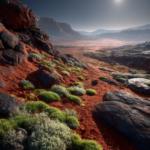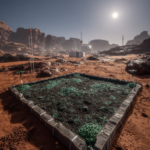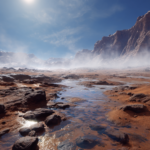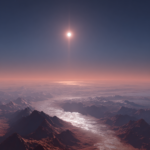
Understanding Mars Today.
Building Tomorrow’s Home.
A Comprehensive Guide to the Red Planet, What Humanity Has Accomplished, and the Road Ahead
Why Mars?
Mars is the only planet in our solar system where humanity has a realistic chance of establishing a second home. Not because it is easy — it is anything but easy — but because Mars offers something no other world in our reach can provide: the raw materials and conditions that, over centuries of deliberate effort, could be transformed into a living, breathing ecosystem capable of sustaining human life without walls, without pressure suits, and without life support machines.
This is not science fiction. This is a multigenerational engineering and biological project that begins with understanding exactly what Mars is today, what has already been accomplished by robotic explorers and visionary engineers, and what steps remain between where we are now and the day a human being walks outside on the Martian surface and breathes open air.
The Mars Habitat Project exists to document that journey — from the first robotic tire tracks in Martian dust to the distant future when forests grow under a Martian sky. More importantly, this project exists to show people on Earth that there are things they can do right now, today, to contribute to making that dream a reality for the generations that will follow us.
Mars Today: A Portrait of the Red Planet
The Basics
Mars is the fourth planet from the Sun, orbiting at an average distance of approximately 228 million kilometers (142 million miles). It is roughly half the diameter of Earth at 6,779 kilometers (4,212 miles) across, making its total surface area comparable to the dry land area of our entire planet. A Martian day — called a sol — is remarkably close to an Earth day at 24 hours, 39 minutes, and 35 seconds. A Martian year, however, stretches to 687 Earth days because of its greater orbital distance.
Mars has an axial tilt of 25.2 degrees, almost identical to Earth’s 23.4 degrees. This gives Mars seasons just like Earth — spring, summer, fall, and winter — though each season lasts roughly twice as long. The planet has two small, irregularly shaped moons: Phobos (roughly 17 miles across) and Deimos (roughly 9 miles across), both likely captured asteroids.
The Atmosphere
This is where the challenges begin in earnest. Mars has an atmosphere, but it is devastatingly thin — less than 1% of Earth’s atmospheric pressure at sea level. The average surface pressure is approximately 610 pascals (0.088 psi), compared to Earth’s 101,325 pascals. To experience equivalent pressure on Earth, you would need to ascend to an altitude of roughly 45 kilometers (28 miles) — well above where any aircraft flies.
The composition of the Martian atmosphere is approximately 95.3% carbon dioxide, 2.7% nitrogen, 1.6% argon, 0.13% oxygen, and 0.03% water vapor, with trace amounts of carbon monoxide, methane, and noble gases. There is no breathable oxygen to speak of. There is no ozone layer. Ultraviolet radiation from the Sun bombards the surface unfiltered, sterilizing exposed organic material.
Under current conditions, liquid water cannot exist on the Martian surface. The atmospheric pressure is so low that water either freezes solid or sublimates directly into vapor. This single fact — no stable liquid water — is one of the most significant barriers to habitability.
Temperature and Climate
Mars is a cold world. The average surface temperature hovers around –60°C (–76°F). Temperature extremes range from as low as –153°C (–243°F) during winter at the poles to a comparatively mild 20°C (68°F) at the equator during summer midday. Daily temperature swings can exceed 100°C because the thin atmosphere retains almost no heat.
Mars experiences dramatic dust storms. Fine particulate dust, electrically charged and pervasive, gets picked up by winds that can reach over 160 km/h (100 mph). Some storms remain localized, while others grow to envelop the entire planet for weeks or months at a time, blocking sunlight and dramatically altering surface conditions. These global dust storms occur roughly every three Martian years.
The planet’s polar ice caps grow and shrink with the seasons. The caps are composed primarily of frozen carbon dioxide (dry ice), with a permanent layer of water ice beneath. During polar winter, up to 30% of the atmospheric carbon dioxide freezes onto the surface at the south pole, causing measurable changes in global atmospheric pressure — a seasonal phenomenon with no equivalent on Earth.
Gravity
Mars’s surface gravity is 38% of Earth’s. A person weighing 180 pounds on Earth would weigh roughly 68 pounds on Mars. While this reduced gravity has practical advantages for construction and movement, the long-term effects of reduced gravity on human biology — including bone density loss, muscle atrophy, cardiovascular changes, and potential impacts on reproduction — remain one of the least understood challenges of permanent habitation.
Water on Mars
Mars has water. It simply does not have it in a usable liquid state on the surface. Substantial reserves of water ice exist at both polar caps and as subsurface permafrost across wide regions of the planet. NASA’s Phoenix lander confirmed water ice just inches below the surface at the north pole in 2008. Orbital radar surveys have identified massive glacial deposits beneath the surface at various latitudes. Some estimates suggest that if the south polar ice cap’s water ice were melted, it could cover the entire Martian surface to a depth of 11 meters (36 feet).
There is overwhelming geological evidence that Mars once had abundant surface water. River channels, eroded valleys, round river cobblestones, ancient lakebeds, and mineral deposits that only form in the presence of liquid water have been documented across the planet. Billions of years ago, Mars had a thicker, warmer atmosphere that allowed rivers, lakes, and possibly oceans to exist. Understanding what Mars lost — and why — is central to understanding how it might one day be restored.
The Missing Magnetosphere
Perhaps the single most critical difference between Earth and Mars is the absence of a global magnetic field. Earth’s magnetosphere, generated by its molten iron core, deflects the solar wind — a continuous stream of charged particles from the Sun. Mars lost its global magnetic field billions of years ago when its core cooled and solidified. Without that protective shield, solar wind has been steadily stripping away the Martian atmosphere ever since.
This is not merely a historical footnote. It is the fundamental obstacle to any terraforming effort. Any atmosphere you attempt to build on Mars will be slowly eroded by solar wind unless magnetic shielding is established first. Solving this problem is arguably the single most important engineering challenge on the path to making Mars habitable.
The Soil
Mars does not have soil. It has regolith — crushed, weathered rock with no organic matter, no microbial life, and no biological nutrient cycling. Much of this regolith contains perchlorates, toxic chlorine-based salts that are harmful to most known life. The concentration of perchlorates varies by region, which is why comprehensive mapping of Martian surface chemistry is so important before any biological remediation is attempted.
Converting sterile, toxic regolith into living soil capable of supporting plant life is one of the great biological challenges of the terraforming timeline. It will require removing or neutralizing perchlorates, introducing microbial life, building organic matter, and establishing nutrient cycling — essentially compressing billions of years of Earth’s soil development into a deliberate, staged process.
What Humanity Has Accomplished So Far
Mars is the most explored planet beyond Earth. Since the 1960s, humanity has sent dozens of missions to Mars — orbiters, landers, and rovers — with an accelerating pace of discovery. What follows is a summary of the most significant milestones and what they have taught us.
The Early Missions: Laying the Groundwork
NASA’s Mariner 4, in 1965, conducted the first successful flyby of Mars, confirming the thin carbon dioxide atmosphere and providing the first close-up photographs. The Viking program in 1976 placed two landers on the Martian surface — the first spacecraft to successfully land on Mars and transmit data back. Viking provided the first in-situ atmospheric measurements and performed the first (inconclusive) experiments searching for signs of life.
In 1997, Mars Pathfinder delivered the Sojourner rover — the first wheeled vehicle to operate on another planet. Though small (roughly the size of a microwave oven), Sojourner proved that mobile robotic exploration of the Martian surface was feasible and opened the door for everything that followed.
Spirit and Opportunity: Proof of Water
NASA’s twin Mars Exploration Rovers, Spirit and Opportunity, landed in January 2004. Their primary mission was to search for evidence of past water activity, and they delivered spectacularly. Spirit found evidence of ancient hot springs. Opportunity discovered mineral deposits — including hematite and jarosite — that could only have formed in the presence of liquid water. Opportunity’s discovery of layered sedimentary rocks consistent with long-standing bodies of water transformed our understanding of Mars from a permanently frozen wasteland to a world that once had lakes and flowing water. Opportunity operated for over 14 years before a planet-encircling dust storm ended its mission in 2018.
Curiosity: A Habitable World
NASA’s Curiosity rover landed in Gale Crater in August 2012, and as of early 2026, it is still operating — more than 13 years into its mission. Curiosity was designed to answer a specific question: Did Mars ever have the right conditions to support microbial life? The answer was a definitive yes. Curiosity found organic molecules, clay minerals, and chemical evidence of freshwater environments that could have supported microbes billions of years ago. It also provided the most detailed atmospheric measurements to date, detecting seasonal methane fluctuations that remain unexplained and tantalizing.
Perseverance: Searching for Life Itself
NASA’s Perseverance rover landed in Jezero Crater — the site of an ancient lake and river delta — in February 2021. Where Curiosity asked whether Mars could have supported life, Perseverance is actively searching for evidence that life actually existed.
As of January 2025, Perseverance has traveled over 20 miles (32.76 kilometers) and collected 33 sample tubes containing rock cores, regolith, and an atmospheric sample. These samples represent the most scientifically significant collection of extraterrestrial material ever assembled. The rover has discovered both igneous and sedimentary rocks showing evidence of water interaction, including a location called “Wildcat Ridge” that preserves conditions that would have been habitable for ancient microbial life. In July 2024, Perseverance discovered intriguing “leopard spots” on a rock nicknamed “Cheyava Falls” with patterns that some scientists believe could indicate biological processes.
MOXIE: Breathing on Mars
One of Perseverance’s most significant technology demonstrations was MOXIE — the Mars Oxygen In-Situ Resource Utilization Experiment. This toaster-sized instrument successfully converted carbon dioxide from the Martian atmosphere into oxygen using solid oxide electrolysis, heating Martian air to approximately 800°C and splitting CO₂ molecules. Over 16 operational runs between April 2021 and September 2023, MOXIE produced 122 grams of oxygen at purities reaching 98%, with peak production rates of 12 grams per hour.
122 grams is not much — roughly enough for an astronaut to breathe for four hours. But MOXIE was never about quantity. It was proof of concept. It proved that we can manufacture oxygen on Mars from the atmosphere that already exists there. A scaled-up version of this technology could produce the 25 metric tons of oxygen needed for a return rocket launch, and provide breathable air for future crews. MOXIE is the first step toward living off the land.
Ingenuity: Flight on Another World
The Ingenuity helicopter, which traveled to Mars on Perseverance’s belly, was designed for five test flights. It flew 72. In an atmosphere only 1% as dense as Earth’s, where conventional aerodynamics said flight should barely be possible, Ingenuity proved that powered, controlled flight works on Mars. It scouted terrain for Perseverance, found safe routes around obstacles, and identified geological features invisible from ground level. Ingenuity completed its final flight in January 2024, far exceeding every expectation. Future Mars exploration will almost certainly include aerial vehicles based on what Ingenuity proved.
The Orbital Fleet
As of 2026, nine spacecraft are actively exploring Mars, five of which are operated by NASA. These include three orbiters — Mars Reconnaissance Orbiter (MRO), MAVEN, and Mars Odyssey — which serve as both scientific instruments and critical communication relays between surface rovers and Earth. The European Space Agency’s Mars Express (launched 2003) and ExoMars Trace Gas Orbiter (launched 2016) continue providing detailed atmospheric data, including measurements of trace gases like hydrogen chloride and the ongoing search for methane. NASA’s MAVEN orbiter has been specifically studying the upper atmosphere and measuring the rate at which solar wind strips away atmospheric gases — data directly relevant to any future atmospheric engineering effort.
NASA’s Vision for Mars
Mars Sample Return: The Unfinished Mission
The rock and soil samples being collected by Perseverance represent what many planetary scientists consider the single most important scientific objective in solar system exploration: returning pristine Martian material to Earth for analysis in laboratories far more sophisticated than anything a rover can carry.
The original NASA-ESA Mars Sample Return (MSR) campaign was designed to send a lander to Jezero Crater, retrieve Perseverance’s cached sample tubes using small helicopters, launch them into Mars orbit aboard a Mars Ascent Vehicle, and rendezvous with a European return orbiter for the journey back to Earth. The project encountered massive cost overruns, with estimates ballooning from $3 billion to $11 billion, and timelines stretching toward 2040.
In January 2025, NASA proposed two redesigned, lower-cost approaches with potential return dates between 2035 and 2039 at costs of $5.5 to $7.7 billion. However, the Trump administration’s fiscal year 2026 budget proposed canceling the MSR program, and in January 2026, Congress confirmed that MSR will not receive funding in its current form. Congress did shift $110 million into a “Mars Future Missions” program to continue developing key technologies, leaving open the possibility that sample return could be revisited in a different form.
Meanwhile, Perseverance continues collecting samples. As of July 2025, 33 of its 43 tubes have been filled, and 10 backup tubes are cached at the Three Forks Sample Depot on the Martian surface. These samples are not going anywhere — they will wait in the Martian dust until someone figures out how to bring them home. China’s Tianwen-3 mission, potentially launching as early as 2028, aims to conduct its own Mars sample return, which could deliver material to Earth by 2031.
NASA’s Broader Mars Strategy
NASA’s Mars Exploration Program continues operating multiple active missions while transitioning toward a new strategic model designed to send lower-cost, higher-frequency missions to Mars. The agency’s long-term goal remains eventual human exploration of Mars, with robotic missions serving as pathfinders that map resources, test technologies (like MOXIE), and identify the safest and most scientifically valuable landing sites for future human crews.
ESA’s Rosalind Franklin rover, a joint project with Russia that was delayed due to geopolitical events, is now scheduled for launch in 2028. It will carry a drill capable of reaching two meters below the Martian surface — deep enough to access material shielded from the sterilizing radiation at the surface, where preserved organic material or even dormant microbial life could theoretically exist.
SpaceX and Elon Musk: The Private Sector Push
No discussion of Mars habitation is complete without addressing the most ambitious private effort in history: SpaceX, founded by Elon Musk in 2002 with the explicit, stated goal of making humanity a multiplanetary species by colonizing Mars.
Starship: The Vehicle
SpaceX’s Starship system is the largest and most powerful rocket ever built, designed specifically for the task of transporting humans and cargo to Mars (and the Moon). The fully stacked vehicle stands approximately 400 feet tall and consists of two stages: the Super Heavy booster (powered by 33 Raptor engines) and the Starship upper stage (powered by 6 Raptor engines). The system is designed to be fully reusable — both stages returning to Earth for rapid turnaround and reflight.
Reusability is not a luxury feature. It is the economic foundation of everything SpaceX plans. Without dramatically reducing launch costs through reuse, transporting the massive quantities of cargo needed to establish a Mars base would be financially impossible. SpaceX’s workhorse Falcon 9 rocket logged its 500th flight in 2025, and the company completed 165 orbital flights that year alone — demonstrating the kind of launch cadence that would be required for Mars operations.
Starship is still in active development. As of early 2026, it has completed multiple test flights with mixed results — some achieving successful landings, others ending in spectacular failures. A fuel leak during the ninth test flight in May 2025 caused uncontrollable spinning and disintegration. Subsequent flights in August and October 2025 achieved successful test landings. The next-generation Block 3 version of Starship, featuring upgraded Raptor 3 engines and approximately 100+ tons of reusable payload capacity, is expected to make its first flight in early 2026.
The Original Mars Timeline
Musk’s Mars ambitions have always been characterized by aggressively optimistic timelines that frequently shift. In 2016, he proposed landing an uncrewed Dragon capsule on Mars by 2018 and crewed missions by 2024. By 2020, those targets moved to 2026 for uncrewed flights. In September 2024, SpaceX announced plans to launch five uncrewed Starships to Mars during the late 2026 transfer window (Earth and Mars align for efficient travel only once every 26 months). These missions would carry Tesla Optimus humanoid robots to begin preparing infrastructure. If landings were successful, crewed missions could follow in the 2028–2029 window, with the ultimate goal of building a self-sustaining city within 20 years.
In May 2025, Musk presented an updated timeline, estimating a 50/50 chance of hitting the late 2026 Mars window and outlining a scaling plan: 5 ships in 2026, 20 ships carrying 75 tons each in 2028–2029, 100 ships in 2031, and eventually 1,000 to 2,000 ships per Mars transit window, each carrying 100 to 200 passengers.
The February 2026 Pivot
On February 9, 2026 — just days before this article was written — Elon Musk announced a significant strategic shift. SpaceX has deprioritized its Mars timeline in favor of establishing a “self-growing city on the Moon,” which Musk stated could be achievable in less than 10 years versus 20+ years for Mars.
The rationale is logistical: Mars launch windows occur only every 26 months with six-month transit times, while missions to the Moon can launch every 10 days with two-day transit times. This allows dramatically faster iteration and learning. Musk stated that SpaceX remains committed to Mars and will “begin doing so in about 5 to 7 years,” but the near-term priority has shifted to the Moon, partly driven by SpaceX’s nearly $3 billion NASA contract to build the Artemis III lunar lander, and pressure from the U.S. government to beat China’s targeted 2030 crewed lunar landing.
This pivot does not mean Mars is abandoned. The technologies being developed for Starship — orbital refueling, reusable heavy-lift capability, life support systems, and in-situ resource utilization — are directly applicable to Mars whether they are first proven on the Moon or not. In many ways, the Moon becomes a proving ground for Mars.
The Path to a Habitable Mars
Making Mars habitable is not a project measured in years. It is measured in centuries. It requires patience, persistence, and the willingness of each generation to build something they will never personally enjoy. Here is the roadmap, broken into ten stages spanning roughly fifteen or more centuries.
Stage 1 — Robotic Reconnaissance (Present Day)
This stage is already underway. Rovers, orbiters, and landers are mapping every aspect of Mars — surface chemistry region by region, subsurface water ice deposits, atmospheric composition, radiation levels, seasonal weather patterns, and dust storm dynamics. You do not modify what you do not understand. Every data point collected today informs every decision that follows. This stage continues indefinitely even as later stages begin.
Stage 2 — Magnetic Shielding Solution (Concurrent with Stage 1)
Before any atmospheric engineering makes sense, Mars needs protection from solar wind. The leading theoretical concept is an artificial magnetic dipole positioned at the Mars-Sun L1 Lagrange point — a gravitationally stable location between Mars and the Sun where an electromagnetic shield could deflect solar wind before it reaches the planet. Research and development on this technology happens on Earth in parallel with robotic exploration. Without solving this problem, every subsequent stage is temporary.
Stage 3 — First Human Presence: Enclosed Habitats and Greenhouses
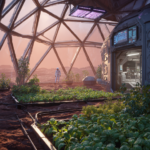
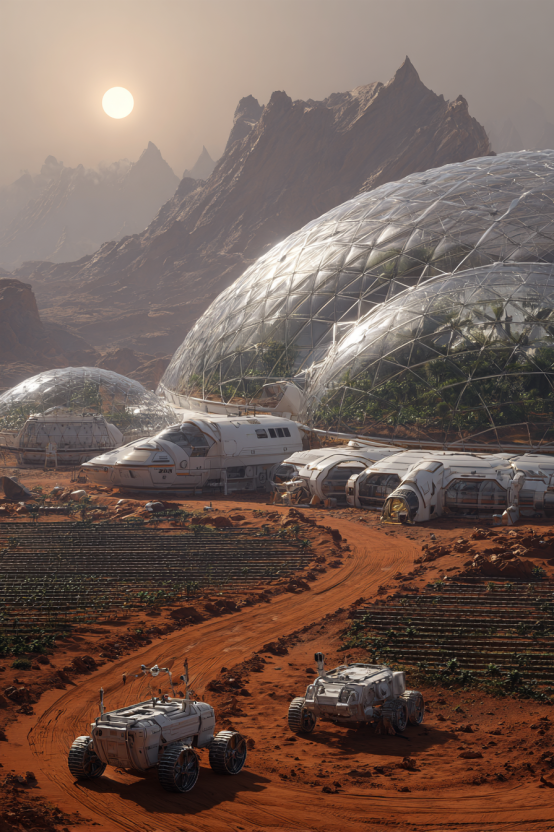
Humans arrive and live in pressurized habitats. Greenhouses serve double duty: sustaining the human population and functioning as research laboratories. Scientists grow plants in actual Martian regolith under controlled conditions. They test what organisms survive, what breaks down perchlorates, what builds soil structure, how water behaves, and how light cycles affect growth. Every experiment is contained, monitored, and documented. Nothing leaves those walls until its effects are fully understood.
Stage 4 — Atmospheric Engineering
With magnetic shielding operational, Mars can begin retaining atmosphere. Targeted warming of polar CO₂ ice caps releases carbon dioxide, thickening atmospheric pressure. Additional greenhouse gases may be introduced to accelerate warming. This stage takes generations. The greenhouses are still running — still feeding people, still testing, still refining what works.
Stage 5 — Water Liberation
As atmospheric pressure and temperature increase, subsurface ice begins melting. Water appears — first as moisture and pooling in low-lying areas, then as flowing surface water. Engineers may accelerate this by targeting ice-rich regions identified during Stage 1 mapping. The water cycle begins forming.
Stage 6 — Controlled Outdoor Test Zones
The critical transition from greenhouse to open surface. Small, prepared zones adjacent to human settlements. Soil in these zones has been remediated based on decades of greenhouse research. Perchlorate-reducing organisms proven successful inside are introduced to limited outdoor patches. Monitored constantly. If something goes wrong, the zone is small and contained. You do not scale what you have not proven.
Stage 7 — Microbial and Primitive Plant Colonization
Successful organisms from Stage 6 expand. Cyanobacteria — the same organisms that originally terraformed Earth billions of years ago — begin working the open surface, photosynthesizing, producing oxygen, and binding soil. Lichens and mosses follow in zones where microbial groundwork has matured. Fungal networks begin forming underground. The greenhouses now function as nurseries, growing what is being introduced outside.
Stage 8 — Advanced Plant Introduction
Hardy grasses, nitrogen-fixing legumes, and fast-growing trees move from greenhouse nurseries to outdoor zones where soil biology can support them. Root systems stabilize ground against erosion. Oxygen production compounds with every generation of growth and decay. Real soil depth begins forming from accumulated organic matter.
Stage 9 — Full Ecosystem Development
Pollinators, decomposers, and animal life are introduced. Food webs form. Weather patterns develop as plant transpiration and surface water interact with the thickening atmosphere. An ozone layer begins forming from accumulated atmospheric oxygen, reducing surface radiation. Humans start spending increasing time outside enclosed habitats.
Stage 10 — Open Habitation
The atmosphere is breathable. Water cycles naturally. Soil supports agriculture. Ecosystems are self-sustaining. Humans live on Mars — not in a box on Mars. The greenhouses that started as survival shelters evolved into research labs, then nurseries, and now they are historical monuments. The planet is alive.
What You Can Do Today
This is the part that matters most. The Mars Habitat Project is not about waiting for billionaires and government agencies to figure it out. It is about recognizing that the knowledge, skills, and technologies required to make another planet habitable begin with work being done right here on Earth, right now, by ordinary people.
Support and Follow the Science
Stay informed about Mars missions. Advocate for planetary science funding. The data being collected today by Perseverance, Curiosity, MAVEN, and other missions is the foundation upon which every future decision will be built. When Mars Sample Return was defunded, it was public and scientific community pressure that preserved $110 million in technology development funding. Public engagement matters.
Invest in Soil Science and Ecology
The single most transferable skill for Mars terraforming is understanding how living soil is built. Composting, vermiculture, mycology, regenerative agriculture, bioremediation of contaminated soils — every advance in turning dead or toxic ground into living, productive soil on Earth is directly applicable to the challenge of converting Martian regolith into something that can sustain life. If you garden, if you compost, if you study how fungi build underground networks, you are practicing skills that Mars will need.
Study and Protect Extremophile Biology
The organisms that will pioneer the Martian surface are extremophiles — life forms that thrive in conditions lethal to most species. Cyanobacteria that survive in Antarctic ice. Lichens that colonize bare volcanic rock. Bacteria that eat perchlorates. Archaea that live in boiling acid springs. Research into these organisms, their genetics, and their survival mechanisms directly contributes to understanding what might survive and work on Mars.
Pursue STEM Education
Mars will need engineers, biologists, atmospheric scientists, botanists, geologists, chemists, and physicists. Every young person who pursues these fields is a potential contributor to humanity’s expansion beyond Earth. Encourage it. Fund it. Celebrate it.
Think in Generations, Not Headlines
The most important shift in thinking is this: Mars habitation is not about us. It is about our great-great-great-grandchildren, and theirs. The decisions being made today — what to study, what to fund, what to build, what to teach — echo forward through centuries. Cathedrals took generations to build. The people who laid the first stones never saw the finished spires. Mars is humanity’s cathedral.