MARS HABITAT PROJECT
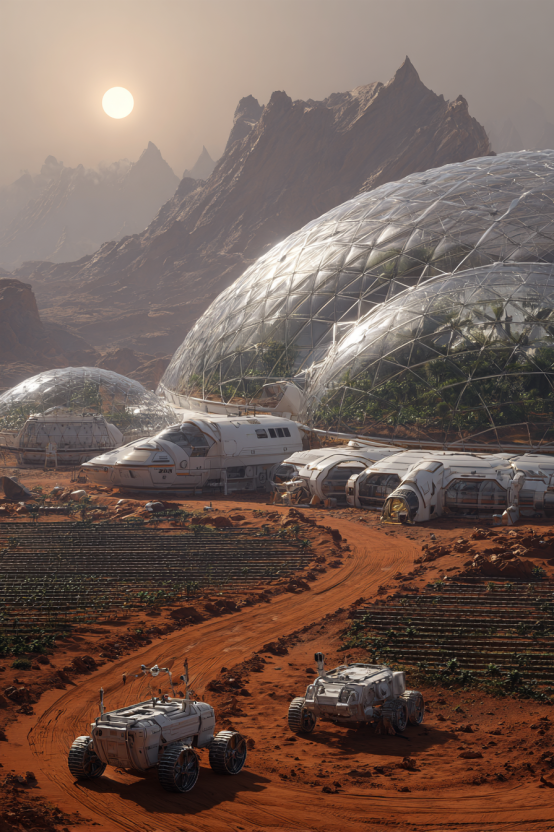
Mars is the only planet in our solar system where humanity has a realistic chance of establishing a second home. Not because it is easy — it is anything but easy — but because Mars offers something no other world in our reach can provide: the raw materials and conditions that, over centuries of deliberate effort, could be transformed into a living, breathing ecosystem capable of sustaining human life without walls, without pressure suits, and without life support machines.
This is not science fiction. This is a multigenerational engineering and biological project that begins with understanding exactly what Mars is today, what has already been accomplished by robotic explorers and visionary engineers, and what steps remain between where we are now and the day a human being walks outside on the Martian surface and breathes open air.
Explore More
This is not science fiction. This is a multigenerational engineering and biological project that begins with understanding exactly what Mars is today, what has already been accomplished by robotic explorers and visionary engineers, and what steps remain between where we are now and the day a human being walks outside on the Martian surface and breathes open air.
STAGE 1: ROBOTIC RECONNAISSANCE

This white paper examines the first and foundational stage of a multigenerational effort to render Mars habitable for open-air human life: robotic reconnaissance. The central argument is that while nearly six decades of robotic Mars exploration have produced extraordinary scientific returns, the reconnaissance conducted to date has been driven primarily by astrobiology and planetary science objectives rather than by the specific informational requirements of habitability engineering.
Significant knowledge gaps persist in areas critical to terraforming feasibility, including comprehensive global regolith chemistry mapping, subsurface hydrological surveying at scale, long-duration atmospheric monitoring across all latitudes, and detailed characterization of the planet’s remnant magnetic field topology.
Explore More
Significant knowledge gaps persist in areas critical to terraforming feasibility, including comprehensive global regolith chemistry mapping, subsurface hydrological surveying at scale, long-duration atmospheric monitoring across all latitudes, and detailed characterization of the planet’s remnant magnetic field topology.
STAGE 2: MAGNETIC SHIELDING

This white paper examines the second stage of the Mars Habitat Project’s ten-stage terraforming framework: the restoration of planetary magnetic shielding. Mars lost its internally generated magnetic field approximately four billion years ago when its core dynamo ceased. Without this protective magnetosphere, the solar wind has continuously stripped the Martian atmosphere, reducing surface pressure to less than 1% of Earth’s and rendering the planet uninhabitable at the surface.
This paper argues that any effort to thicken the Martian atmosphere — the central objective of stages four and five of the framework — is futile without first solving the problem of atmospheric retention. Building an atmosphere only to have it stripped away is not terraforming; it is filling a bathtub with no plug.
Explore More
This paper argues that any effort to thicken the Martian atmosphere — the central objective of stages four and five of the framework — is futile without first solving the problem of atmospheric retention. Building an atmosphere only to have it stripped away is not terraforming; it is filling a bathtub with no plug.
STAGE 3: FIRST HUMAN PRESENCE
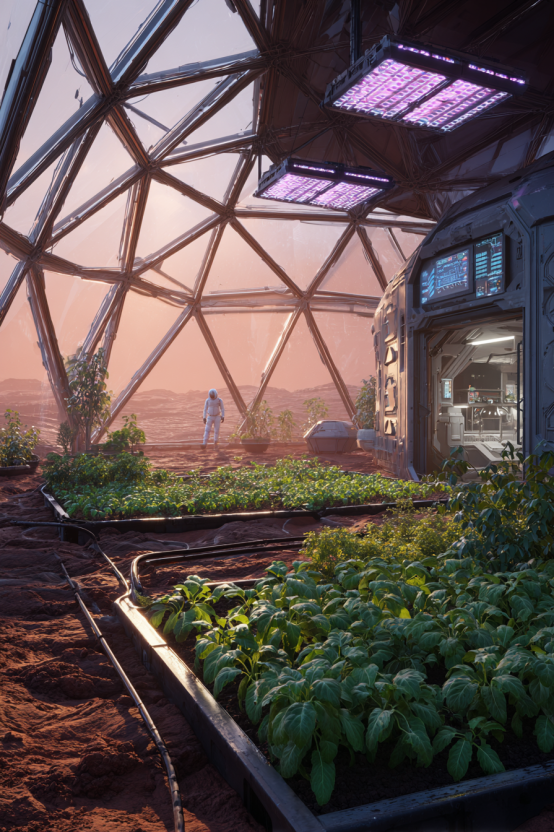
This paper examines the third stage of the Mars Habitat Project’s ten-stage terraforming framework: the arrival of human beings on Mars and their establishment within pressurized enclosed habitats and research greenhouses. Stage 3 is the transition from robotic exploration to human presence, but it is emphatically not the beginning of terraforming. It is the beginning of learning to terraform. Greenhouses in this stage serve double duty: they sustain the human population through food and oxygen production, and they function as the most important research laboratories in the solar system.
Within their walls, scientists conduct the first experiments with actual Martian regolith under controlled conditions — testing which organisms survive, which bacteria and processes break down perchlorates, how water behaves under Martian gravity and pressure differentials, how the 24-hour-39-minute Martian sol affects plant circadian rhythms, and what it takes to transform sterile rock dust into living soil.
Explore More
Within their walls, scientists conduct the first experiments with actual Martian regolith under controlled conditions — testing which organisms survive, which bacteria and processes break down perchlorates, how water behaves under Martian gravity and pressure differentials, how the 24-hour-39-minute Martian sol affects plant circadian rhythms, and what it takes to transform sterile rock dust into living soil.
STAGE 4: ATMOSPHERIC ENGINEERING

This paper examines the fourth stage of the Mars Habitat Project’s ten-stage terraforming framework: the deliberate engineering of Mars’s atmosphere. Stage 4 is the first intervention that operates at planetary scale, and it depends absolutely on the magnetic shielding established in Stage 2. Without a mechanism to retain atmosphere against solar wind stripping, any gas added to Mars bleeds into space — a bathtub with no plug.
With the plug in place, Stage 4 begins the slow, multigenerational process of warming the planet, sublimating polar CO₂ ice deposits, introducing additional greenhouse agents, and initiating the positive feedback loop in which warming releases more CO₂, which traps more heat, which drives more warming.
Explore More
With the plug in place, Stage 4 begins the slow, multigenerational process of warming the planet, sublimating polar CO₂ ice deposits, introducing additional greenhouse agents, and initiating the positive feedback loop in which warming releases more CO₂, which traps more heat, which drives more warming.
STAGE 5: WATER LIBERATION
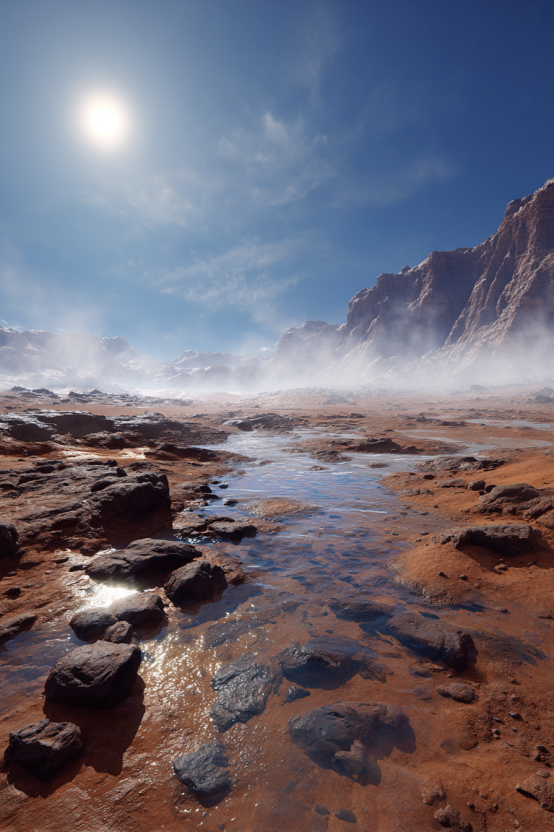
This paper examines the fifth stage of the Mars Habitat Project’s ten-stage terraforming framework: the liberation of water from Mars’s vast frozen reserves. Stage 5 is a direct consequence of Stage 4 — as atmospheric pressure and temperature rise from engineered warming, subsurface ice that has been locked in the Martian crust for billions of years begins to melt.
Water appears first as moisture seeping through warmed regolith, then as seasonal pooling in low-lying basins, then as persistent surface water in the deepest and warmest locations. This transition is not instantaneous. It is governed by the physics of the water phase diagram, the depth and distribution of buried ice, the non-uniform warming pattern produced by Stage 4, and the geological reality that Mars’s water inventory — though enormous — is buried at varying depths and locked in varying states.
Explore More
Water appears first as moisture seeping through warmed regolith, then as seasonal pooling in low-lying basins, then as persistent surface water in the deepest and warmest locations. This transition is not instantaneous. It is governed by the physics of the water phase diagram, the depth and distribution of buried ice, the non-uniform warming pattern produced by Stage 4, and the geological reality that Mars’s water inventory — though enormous — is buried at varying depths and locked in varying states.
STAGE 6: CONTROLLED OUTDOOR TEST ZONES
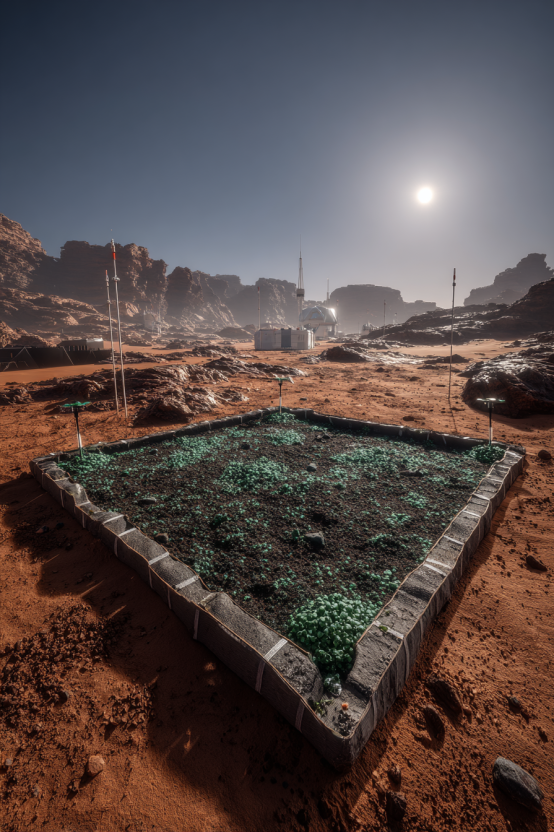
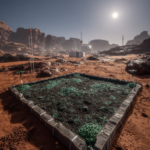
This paper describes the sixth stage of the Mars Habitat Project’s terraforming framework: the establishment of controlled outdoor test zones — small, prepared patches of Martian surface adjacent to human settlements where biology meets the open Martian environment for the first time. Everything before this point has happened inside. Stage 3’s greenhouses proved that terrestrial organisms can grow in Martian regolith under controlled conditions.
Stage 5’s water liberation delivered liquid water to the surface for the first time since the Hesperian. Stage 6 is the moment those greenhouse lessons step outside. The zones are small by design. Soil in each test zone has been remediated through processes refined over decades of greenhouse research — perchlorate-reducing bacteria proven successful indoors are introduced to limited outdoor patches where they face actual Martian UV radiation, cosmic ray flux, temperature extremes, and atmospheric composition for the first time.
Explore More
Stage 5’s water liberation delivered liquid water to the surface for the first time since the Hesperian. Stage 6 is the moment those greenhouse lessons step outside. The zones are small by design. Soil in each test zone has been remediated through processes refined over decades of greenhouse research — perchlorate-reducing bacteria proven successful indoors are introduced to limited outdoor patches where they face actual Martian UV radiation, cosmic ray flux, temperature extremes, and atmospheric composition for the first time.
STAGE 7: MICROBIAL AND PRIMITIVE PLANT COLONIZATION
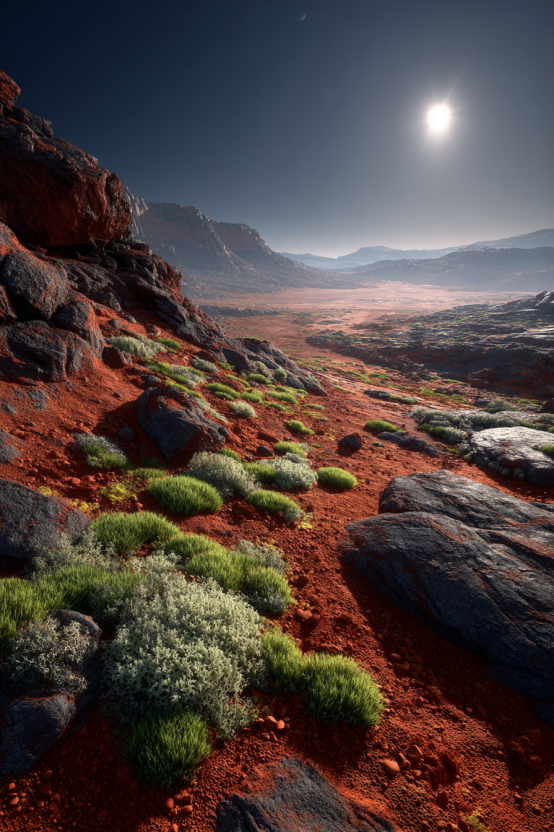
This paper describes the seventh stage of the Mars Habitat Project’s terraforming framework: the expansion of successful biology from Stage 6’s bounded test zones onto the open Martian surface at landscape scale. Stage 6 proved that specific organisms could survive and function outdoors under real Martian conditions.
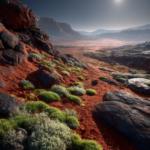
Stage 7 takes what worked and lets it spread. Cyanobacteria — the same class of organisms that originally terraformed Earth approximately 2.4 billion years ago during the Great Oxidation Event — begin colonizing prepared surfaces beyond the test zone perimeters, photosynthesizing, producing molecular oxygen, fixing atmospheric nitrogen, and secreting the extracellular polysaccharides that bind mineral particles into soil. Where cyanobacterial biocrusts have matured sufficiently, lichens are introduced — those ancient symbiotic partnerships between fungi and photosynthetic partners that are Earth’s primary pioneers of bare rock.
Explore More
Stage 7 takes what worked and lets it spread. Cyanobacteria — the same class of organisms that originally terraformed Earth approximately 2.4 billion years ago during the Great Oxidation Event — begin colonizing prepared surfaces beyond the test zone perimeters, photosynthesizing, producing molecular oxygen, fixing atmospheric nitrogen, and secreting the extracellular polysaccharides that bind mineral particles into soil. Where cyanobacterial biocrusts have matured sufficiently, lichens are introduced — those ancient symbiotic partnerships between fungi and photosynthetic partners that are Earth’s primary pioneers of bare rock.
STAGE 8: ADVANCED PLANT INTRODUCTION
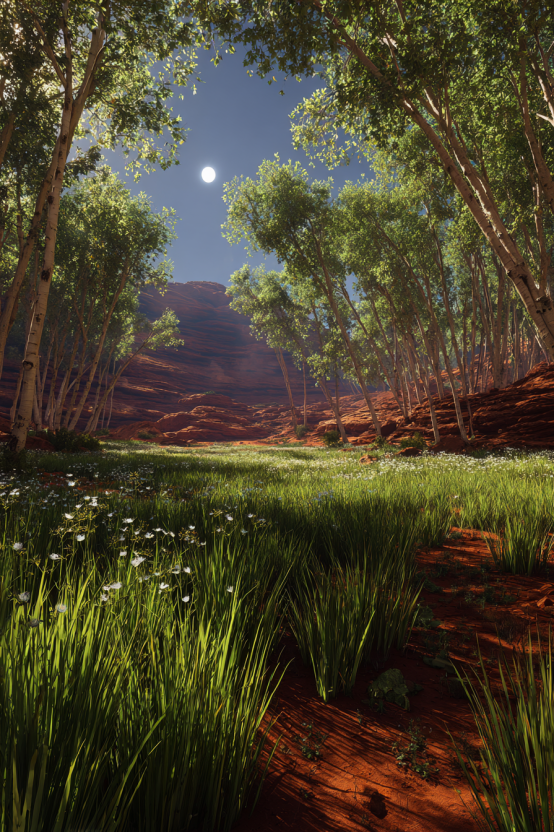
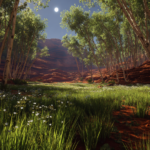
This paper describes the eighth stage of the Mars Habitat Project’s terraforming framework: the introduction of vascular plants to outdoor Martian soil that has been biologically prepared by the microbial and primitive plant colonization of Stage 7. Where cyanobacterial biocrusts, lichens, mosses, and fungal networks have built enough organic matter, fixed enough nitrogen, and retained enough moisture to constitute functional soil, Stage 8 plants the first grasses, legumes, and trees. These are not decorative additions. They are structural and biochemical transformations of the Martian surface.
Hardy grasses send fibrous root systems through the developing soil profile, binding particles mechanically, preventing wind erosion, and creating root channels that improve water infiltration and gas exchange. Nitrogen-fixing legumes — plants that host symbiotic Rhizobium bacteria in root nodules — dramatically accelerate the nitrogen economy of the soil, converting atmospheric N₂ into bioavailable ammonium at rates far exceeding free-living cyanobacterial fixation.
Explore More
Hardy grasses send fibrous root systems through the developing soil profile, binding particles mechanically, preventing wind erosion, and creating root channels that improve water infiltration and gas exchange. Nitrogen-fixing legumes — plants that host symbiotic Rhizobium bacteria in root nodules — dramatically accelerate the nitrogen economy of the soil, converting atmospheric N₂ into bioavailable ammonium at rates far exceeding free-living cyanobacterial fixation.
STAGE 9: FULL ECOSYSTEM DEVELOPMENT

This paper describes the ninth stage of the Mars Habitat Project’s terraforming framework: the development of complete ecosystems on the Martian surface. Stages 7 and 8 established the biological foundation — microbial communities, biocrusts, lichens, mosses, grasses, legumes, trees, and the mycorrhizal networks connecting them. Stage 9 adds the rest. Pollinators arrive: bees, moths, butterflies, and other insects whose movement between flowers enables sexual reproduction in the flowering plants that dominate Stage 8’s grasslands and legume fields. Decomposers arrive: earthworms, soil mites, springtails, beetles, and the vast microbial consortia that break down dead organic matter and return its nutrients to the soil.
Animal life follows: first invertebrates, then small vertebrates, occupying the ecological niches that plant communities have created. Food webs form — not designed by humans, but emergent from the interactions of the species present — and with them the self-regulating dynamics that characterize a living ecosystem. Meanwhile, the physical planet is changing around this biology.
Explore More
Animal life follows: first invertebrates, then small vertebrates, occupying the ecological niches that plant communities have created. Food webs form — not designed by humans, but emergent from the interactions of the species present — and with them the self-regulating dynamics that characterize a living ecosystem. Meanwhile, the physical planet is changing around this biology.
STAGE 10: OPEN HABITATION
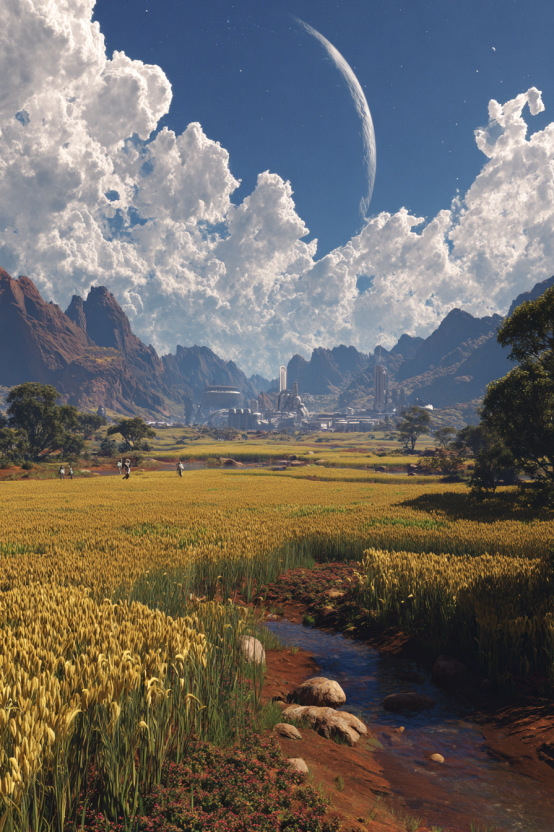
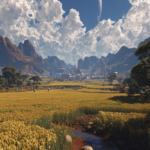
This paper describes the tenth and final stage of the Mars Habitat Project’s terraforming framework: open habitation. The atmosphere is breathable. Not Earth-normal — thinner, cooler, with a different gas ratio — but breathable: sufficient oxygen partial pressure for sustained human respiration without supplemental equipment, sufficient total pressure to eliminate the need for pressure garments, and a mature ozone layer that reduces surface ultraviolet radiation to levels compatible with unprotected human skin exposure. Water cycles naturally: precipitation falls from clouds formed by biological transpiration and surface evaporation, flows across the surface in streams and seasonal rivers, percolates through soil into subsurface aquifers, and is drawn back up by plant roots to transpire into the atmosphere again.
Soil supports agriculture: decades of organic matter accumulation, nutrient cycling by decomposer communities, mycorrhizal network development, and earthworm engineering have produced soils deep enough, fertile enough, and biologically active enough to grow food crops outdoors without the controlled environment of a greenhouse.
Explore More
Soil supports agriculture: decades of organic matter accumulation, nutrient cycling by decomposer communities, mycorrhizal network development, and earthworm engineering have produced soils deep enough, fertile enough, and biologically active enough to grow food crops outdoors without the controlled environment of a greenhouse.