A White Paper on Expanding Biology
Beyond the Test Zones and onto the Open Surface of Mars
———————————————
Cyanobacterial Biocrusts, Lichen Succession, Moss Establishment,
Mycorrhizal Networks, and the Greenhouse as Nursery
Abstract
This paper describes the seventh stage of the Mars Habitat Project’s terraforming framework: the expansion of successful biology from Stage 6’s bounded test zones onto the open Martian surface at landscape scale. Stage 6 proved that specific organisms could survive and function outdoors under real Martian conditions.
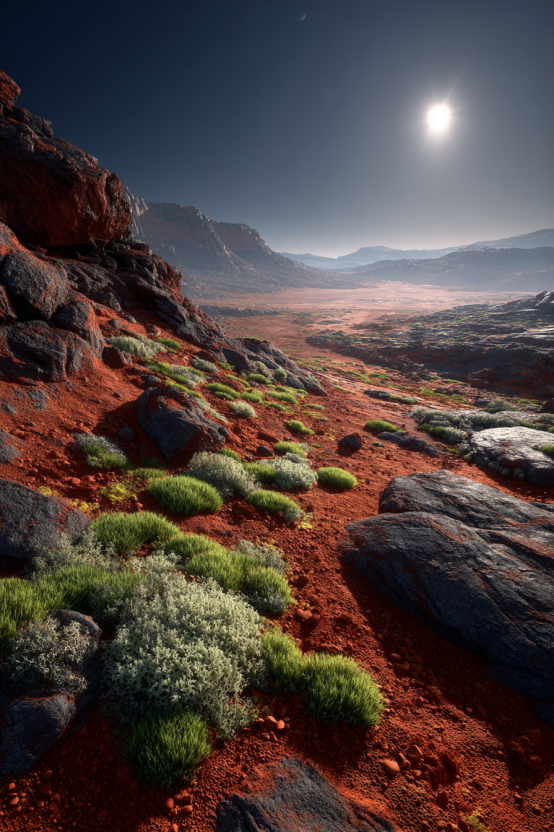
Stage 7 takes what worked and lets it spread. Cyanobacteria — the same class of organisms that originally terraformed Earth approximately 2.4 billion years ago during the Great Oxidation Event — begin colonizing prepared surfaces beyond the test zone perimeters, photosynthesizing, producing molecular oxygen, fixing atmospheric nitrogen, and secreting the extracellular polysaccharides that bind mineral particles into soil. Where cyanobacterial biocrusts have matured sufficiently, lichens are introduced — those ancient symbiotic partnerships between fungi and photosynthetic partners that are Earth’s primary pioneers of bare rock.
Where lichens and biocrusts have built enough organic matter, mosses follow, deepening the soil and increasing water retention. Below the surface, fungal hyphae begin extending through the remediated regolith, forming the earliest mycorrhizal networks — the underground architecture that, on Earth, connects approximately 80 percent of all terrestrial plant species into cooperative nutrient-sharing systems. The greenhouses of Stage 3, which have operated continuously since the earliest human presence, now serve their final and most important function: as nurseries, propagating the organisms that are being introduced outside. This paper details the ecological logic of this expansion, the organisms involved, the succession sequence, the role of fungal networks in building a functional soil ecosystem, the transition of greenhouses from food production facilities to biological nurseries, and the monitoring systems that track whether Mars is becoming, for the first time in three billion years, a living surface.
1. Introduction
1.1 What Stage 6 Proved
Stage 6 established controlled outdoor test zones — small, bounded patches of Martian surface where organisms that had been proven in greenhouse conditions were tested against the real Martian environment. The results of those tests determine everything that follows. Where perchlorate-reducing bacteria successfully lowered soil toxicity to biologically tolerable levels under open conditions, where cyanobacterial biocrusts established and persisted through multiple Martian years without continuous human intervention beyond irrigation, where soil organic carbon content measurably increased, and where the biological community survived dust storms and solar particle events without total collapse — in those zones, Stage 6 answered its central question: yes, biology can function on the open Martian surface. Stage 7 begins in the zones where that answer was affirmative.
But Stage 7 is not simply Stage 6 with larger boundaries. The shift from contained experiment to managed expansion changes the nature of the enterprise. In Stage 6, every gram of inoculant was delivered by hand. Every liter of water was metered. Every square meter was monitored by dedicated instrument packages. In Stage 7, the biological systems being deployed must begin to sustain themselves — not completely, not yet without human support, but with increasing autonomy. Cyanobacteria that were hand-inoculated in Stage 6 must now reproduce and spread under their own power. Biocrusts that formed on prepared soil must now extend onto adjacent unprepared regolith. The arc of Stage 7 is from managed introduction to self-sustaining colonization, and that arc is the most critical transition in the entire framework.
1.2 What Happened on Earth
The colonization strategy described in this paper is not speculative. It is a replay — deliberate and informed — of the process by which life originally transformed Earth from a sterile rock into a habitable planet. Approximately 2.7 billion years ago, cyanobacteria evolved oxygenic photosynthesis — the ability to use water as a fuel source and release molecular oxygen as a byproduct. They were the first and, for billions of years, the only organisms capable of this chemistry. The oxygen they produced was initially consumed by chemical reactions with dissolved iron in the oceans and reduced minerals in the crust. But over a span of 200 to 300 million years, cyanobacterial oxygen production outpaced these sinks, and free oxygen began accumulating in the atmosphere. The result was the Great Oxidation Event approximately 2.4 billion years ago — the most significant chemical revolution in Earth’s history, which transformed the atmosphere from reducing to oxidizing, enabled the evolution of aerobic metabolism, and ultimately made complex multicellular life possible. Every breath taken by every animal on Earth is possible because cyanobacteria changed the atmosphere first.
Cyanobacteria also built the first soils. Their extracellular polysaccharide secretions bound mineral particles together. Their nitrogen fixation made bioavailable nitrogen available in substrates that contained none. Their photosynthetic carbon fixation introduced organic matter into sterile mineral surfaces. When they died, their biomass decomposed into the organic fraction that distinguishes soil from crushed rock. The biological soil crusts they formed — living surfaces of intertwined cyanobacterial filaments, EPS matrices, trapped sediment, and associated microbial communities — remain the primary mechanism by which bare mineral substrates are colonized by life on Earth today. This is observable in real time: on newly exposed glacial moraines, on volcanic rock, on desert pavements. The process is not ancient history. It is ongoing ecology, and it is the template for Stage 7.
1.3 The Succession Sequence
Primary ecological succession — the colonization of bare, lifeless substrate by biology — follows a predictable sequence on Earth. First, microorganisms (bacteria, cyanobacteria) colonize the surface and begin modifying it: fixing nitrogen, adding carbon, producing EPS, weathering minerals. Second, lichens arrive — symbiotic associations of fungi and photosynthetic algae or cyanobacteria that can survive on bare rock and produce acids that accelerate mineral weathering. Third, mosses establish in the thin soils created by lichens and microbial crusts, deepening those soils through their growth and decomposition. Fourth, vascular plants take root in the soil that mosses and lichens have built. Fifth, fungal networks connect the roots of these plants into cooperative nutrient-sharing systems, creating the underground infrastructure of a mature ecosystem. Each stage modifies the habitat in ways that make the next stage possible. Each stage depends on the one before it. This is the sequence Stage 7 follows on Mars — not because it is the only conceivable approach, but because it is the approach that has been proven to work on the only planet where life has ever colonized a mineral surface.
2. Cyanobacteria: The Foundation
2.1 Why Cyanobacteria Come First
Cyanobacteria are deployed first in Stage 7’s expansion for the same reason they came first on Earth: they are the only prokaryotes capable of oxygenic photosynthesis, and they require nothing from the substrate except minerals, water, light, and atmospheric gases. They do not need organic matter in the soil because they manufacture it. They do not need bioavailable nitrogen because they fix it from atmospheric N₂. They do not need other organisms to prepare the way because they are the organisms that prepare the way. On Mars, where the regolith is a sterile basaltic mineral substrate with no organic carbon, no bioavailable nitrogen, and no biological history, cyanobacteria are the only class of organisms that can colonize from zero.
The specific genera selected for Stage 7 expansion are those that demonstrated survival and function in Stage 6’s outdoor test zones. Chroococcidiopsis, the desiccation-tolerant, radiation-resistant genus isolated from Negev Desert and Antarctic endolithic habitats, provides the extremophile anchor — the organism most likely to survive the harshest microenvironments on the expanding frontier. Its UV-screening pigment scytonemin, its mycosporine-like amino acids, its thick EPS matrix, and its capacity for anhydrobiosis make it uniquely suited to the Martian surface. Anabaena and Nostoc species provide the nitrogen-fixation capability essential for building bioavailable nitrogen stocks in the soil. Filamentous forms such as Desmonostoc muscorum and Anabaena cylindrica, which grew successfully on MGS-1 and MMS-2 Mars regolith simulants and survived combined desiccation and UV-B stress, provide the structural filaments that physically weave through and bind mineral particles into the cohesive fabric of a biocrust.
2.2 What Cyanobacterial Colonization Produces
When cyanobacteria colonize a mineral surface, they produce five outputs that transform the substrate. First, oxygen: every molecule of CO₂ fixed by photosynthesis releases one molecule of O₂. On Earth, this output changed the planet’s atmosphere over geological time. On Mars, cyanobacterial oxygen production will be minuscule relative to the atmospheric volume, but it is locally significant — measurable in the near-surface air above active biocrusts, and a biomarker that confirms photosynthetic activity is occurring. Second, fixed carbon: photosynthesis converts atmospheric CO₂ into organic molecules that become the carbon source for the entire soil food web. Every gram of organic carbon in the Martian soil originates, directly or indirectly, from photosynthetic fixation. Third, fixed nitrogen: diazotrophic cyanobacteria (Anabaena, Nostoc) convert atmospheric N₂ into ammonium (NH₄⁺), making nitrogen available to organisms that cannot fix it themselves. This is the critical nutrient bottleneck in primary succession, and cyanobacteria are the organisms that break it. Fourth, extracellular polysaccharides: EPS secretions bind mineral particles into aggregates, increase the water-holding capacity of the soil, create microhabitats that retain moisture during desiccation, and provide a physical matrix that protects embedded cells from UV radiation. Research confirms that cyanobacterial filaments interweave to form complex three-dimensional network structures that capture and stabilize soil particles into aggregating structures. Fifth, biomass: when cyanobacterial cells die, their organic matter decomposes and becomes the humic fraction of the developing soil. This is the material that transforms regolith into something capable of supporting higher organisms.
2.3 Biocrust Formation and Expansion
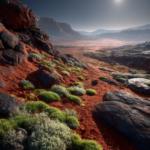
The visible product of cyanobacterial colonization is the biological soil crust — a darkened, cohesive surface layer typically a few millimeters to a few centimeters thick, composed of living cyanobacterial filaments, EPS matrix, trapped mineral particles, and associated heterotrophic bacteria. On Earth, cyanobacteria-dominated biocrusts recover within five to ten years in favorable conditions after disturbance; lichen- and moss-dominated crusts take ten to twenty years. On Mars, where conditions are far harsher, the timeline will be longer, but the process is the same. Stage 7 manages this process by expanding the area available for colonization in increments. When a Stage 6 test zone’s biocrust reaches the zone boundary and demonstrates the capacity for lateral growth, the boundary is extended or removed, and the biocrust is allowed to spread onto adjacent regolith that has been minimally prepared — perchlorate-reduced but not amended with organic matter, since the cyanobacteria will supply their own. The expansion rate is determined by the organisms, not by human schedule. The role of the human operators is to prepare the path, remove barriers, supply water, and monitor. The organisms do the colonizing.
3. Lichens: The Second Wave
3.1 Why Lichens Follow Cyanobacteria
Lichens are not single organisms. They are symbiotic associations — partnerships between a fungal partner (the mycobiont) and a photosynthetic partner (the photobiont), which may be a green alga, a cyanobacterium, or both. The fungus provides structural support, protection from desiccation, and access to mineral nutrients extracted from the substrate through acid secretion. The photobiont provides photosynthetically fixed carbon. This partnership allows lichens to colonize environments that neither partner could survive alone — bare rock surfaces, extreme temperatures, intense radiation, and prolonged drought. On Earth, lichens are the primary colonizers of bare rock in primary succession, arriving after microbial pioneers have begun the process of surface modification.
On Mars, lichens follow cyanobacterial biocrusts for two reasons. First, the biocrust provides a substrate that has been partially modified — organic carbon has been added, the mineral surface has been weathered by cyanobacterial acid secretion, moisture retention has improved from EPS deposition, and the most extreme surface photochemistry has been partially buffered by the biological layer. Lichens do not require rich soil, but they do require a surface that is not actively sterilizing everything on contact — the UV-driven reactive oxygen species production that characterizes raw Martian regolith is attenuated beneath a biocrust. Second, the photobiont in many lichen species is itself a cyanobacterium, often Nostoc or Chroococcidiopsis — the same genera already established in the biocrust. The lichen is, in a sense, a fungus recruiting an already-present cyanobacterial partner into a more complex and more protected collaborative structure.
3.2 What Lichens Add
Lichens accelerate soil formation through mechanisms that cyanobacteria alone cannot provide. Their fungal hyphae penetrate rock and mineral surfaces physically, widening cracks and fractures, increasing the surface area available for chemical weathering. They secrete oxalic acid and carbonic acid, which dissolve mineral bonds and liberate nutrient ions (calcium, magnesium, potassium, phosphorus, iron) from the rock matrix. On Earth, this bioweathering is the primary process by which bare rock becomes mineral soil over decades to centuries. On Mars, where the regolith is already fragmented (it is dust and sand, not solid bedrock), the chemical weathering function of lichens is more important than the physical: they mobilize nutrients from mineral grains that are inaccessible to plants and microorganisms that lack the acid-secretion capability.
Lichens also increase the structural complexity of the surface ecosystem. Where biocrusts are essentially two-dimensional living surfaces, lichens create three-dimensional structures — thalli that rise above the surface, trap windblown sediment and organic debris, create sheltered microhabitats beneath their canopy, and intercept moisture from dew and fog. Metabolically active Diploschistes muscorum has been shown to withstand the X-ray dose equivalent of one year on the Mars surface during strong solar activity, with the heavy crystalline deposits on its thallus providing radiation shielding. This structural and biochemical resilience makes certain lichen species viable candidates for Martian surface colonization in zones where biocrusts have established the biological foundation.
3.3 Lichen Introduction Protocol
Lichens are not seeded like bacteria. They are propagated in the greenhouse as intact thalli or as fragmented soredia (reproductive propagules containing both fungal and photobiont cells) and physically placed onto mature biocrust surfaces in the expanding colonization zones. The introduction protocol is conservative: small numbers of thalli placed at intervals across a zone, with survival monitored over multiple Martian seasons before additional introductions are made. The success criterion is not merely survival but establishment — growth of the thallus, production of reproductive structures, and visible modification of the substrate beneath the lichen (darkening from acid weathering, accumulation of fine mineral particles, development of an organic layer between the lichen and the biocrust). Failed introductions inform subsequent attempts: different species, different placement strategies, different seasonal timing. As with every element of this framework, the pace is set by results, not by ambition.
4. Mosses: Deepening the Soil
4.1 The Role of Mosses in Primary Succession
On Earth, mosses are the organisms that transform thin, immature soils into substrates capable of supporting vascular plants. Where lichens and biocrusts create soil measured in millimeters, mosses create soil measured in centimeters. They do this through three mechanisms. First, their dense growth form traps windblown mineral and organic particles, accumulating material faster than any crust or lichen can. Second, their tissues hold water like a sponge — mosses can absorb and retain many times their dry weight in water, dramatically increasing the moisture-holding capacity of the surface they colonize. Third, their decomposing biomass produces humic substances that further improve soil structure, nutrient retention, and water-holding capacity. On glacial moraines, volcanic substrates, and sand dunes, the transition from lichen-dominated to moss-dominated surface marks the point at which the soil becomes deep and moist enough to support root penetration by vascular plants.
4.2 Moss Candidates for Mars
Mosses are considerably more complex than cyanobacteria or lichens, and their requirements are correspondingly greater. They need more water, more stable temperatures, and more protection from UV radiation than the pioneer organisms. On present-day Mars — even after Stage 4’s warming and atmospheric thickening — unshielded moss survival on the open surface is unlikely. Mosses in Stage 7 are therefore restricted to zones where conditions are most favorable: low-lying areas with higher atmospheric pressure, locations near Stage 5 water sources where irrigation is reliable, surfaces where biocrust and lichen colonization have been ongoing for years and the organic layer provides some buffering against UV and desiccation, and locations where Stage 4’s atmospheric progress has provided meaningfully increased UV shielding.
Candidate species are drawn from Earth’s most stress-tolerant bryophytes. Antarctic and Arctic mosses that survive months of complete darkness, extreme cold, and desiccation. Desert mosses from the Negev and Atacama that tolerate intense UV and prolonged drought. Endolithic and cryptoendolithic species that grow within or beneath rock surfaces. In the greenhouse nurseries, these species are cultivated on Mars regolith simulant under progressively more Mars-like conditions — reduced atmospheric pressure, elevated CO₂, reduced temperature, increased UV exposure — to acclimate populations before outdoor introduction. The moss introductions represent the most ambitious biological deployment in Stage 7, and they are the most likely to fail in the early expansion phases. That is accepted. The information from early failures guides later attempts, and the expanding atmospheric shield from Stage 4 makes each subsequent year more favorable than the last.
5. Fungal Networks: Building the Underground
5.1 What Mycorrhizal Networks Do on Earth
Beneath the surface of virtually every terrestrial ecosystem lies an infrastructure of fungal hyphae so vast and so fundamental that its importance was not fully appreciated until recent decades. Mycorrhizal fungi form symbiotic associations with approximately 80 percent of all terrestrial plant species. The fungus colonizes plant roots and extends its hyphae through the soil, accessing nutrient sources and soil spaces that roots alone cannot reach. In exchange for photosynthetically fixed carbon from the plant, the fungus delivers phosphorus, nitrogen, water, and micronutrients. These networks are responsible for sequestering approximately 13 billion tons of carbon dioxide per year — more than a third of global annual fossil fuel emissions. Their hyphae weave structure into soils, preventing erosion. Their glomalin-related soil proteins act as biological glue, binding soil aggregates into stable structures. Without mycorrhizal networks, terrestrial soil ecosystems as we know them would not exist.
The symbiotic relationship between mycorrhizal fungi and plants is ancient — documented in the fossil record approximately 400 million years ago, coinciding with the first colonization of land by plants. The fungi did not follow plants onto land; they enabled it. Early land plants lacked the root systems to extract nutrients from mineral substrates. Mycorrhizal fungi provided the nutrient-acquisition infrastructure that made terrestrial plant life possible. The relationship is not optional: most terrestrial plants cannot thrive without their fungal partners, and most mycorrhizal fungi cannot survive without their plant hosts. This obligate mutualism is the foundation of terrestrial soil ecology, and establishing it on Mars is essential for any long-term vision of a self-sustaining surface ecosystem.
5.2 Arbuscular and Ectomycorrhizal Systems
Two major classes of mycorrhizal association are relevant to Stage 7. Arbuscular mycorrhizal (AM) fungi, from the phylum Glomeromycota, are the most ancient and widespread type, associating with roughly 80 percent of land plant species including most crops and grasses. AM fungi penetrate root cells and form arbuscules — tree-shaped structures that serve as the interface for nutrient exchange between fungus and plant. They are not host-specific: a single AM fungal species can colonize a wide range of plant species, and plants colonized by the same fungal species become interconnected by what is known as a common mycorrhizal network (CMN). Through these networks, nutrients and signaling compounds can be transferred between connected plants, enabling resource sharing and communication across the plant community. Ectomycorrhizal (EM) fungi form sheaths around root tips rather than penetrating cells. They associate with fewer plant species but tend to partner with dominant forest trees — conifers, oaks, birches, dipterocarps. EM fungi exhibit greater host specificity and produce the familiar mushrooms and truffles. Both types will eventually be needed on Mars, but AM fungi are the priority for Stage 7 because they associate with the pioneer plants (grasses, legumes, and forbs) that will be the first vascular plants introduced.
5.3 Establishing Fungal Networks on Mars
Fungal hyphae cannot survive on the raw Martian surface. They require organic matter in the soil, moisture, moderate temperatures, and protection from UV radiation. All of these conditions are created by the preceding stages of biological colonization. Where cyanobacterial biocrusts have added organic carbon to the soil, where lichens have weathered minerals and deepened the organic layer, where mosses have increased water retention, and where the growing atmospheric shield has reduced UV penetration — in those zones, the subsurface environment begins to approach conditions compatible with fungal growth. Fungi introduced to the soil in these zones will initially be free-living saprophytic species that decompose dead cyanobacterial and moss biomass, recycling nutrients and further building soil organic matter. Mycorrhizal species are introduced in tandem with the first vascular plant introductions, inoculated directly onto plant roots in the greenhouse nursery before the plants are transplanted outdoors. The plant and its fungal partner arrive as a unit, the mycorrhizal association already established before the plant faces outdoor conditions.
The development of functional mycorrhizal networks on Mars will be slow. On Earth, the expansion of fungal mycelium through soil involves specialized growing tips that act as pathfinders, pulling behind them dense networks of nutrient-absorbing hyphae. The bidirectional transport of nutrients through these networks — carbon flowing from plant to fungus, phosphorus and nitrogen flowing from fungus to plant — creates the metabolic architecture that supports plant communities. On Mars, the networks must establish in soils with far less organic matter, far less moisture, and far more hostile chemistry than any terrestrial environment. The early networks will be fragile, limited in extent, and dependent on continuous water supply. But they will exist. And their existence represents a qualitative transition: from a surface where individual organisms survive in isolation to an ecosystem where organisms are connected, cooperative, and interdependent. That transition is the difference between colonization and ecology.
6. The Greenhouse as Nursery
6.1 The Transformation of Purpose
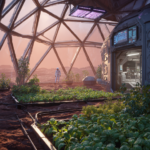
The greenhouses of Stage 3 were built to do three things: produce food for the human settlement, serve as biological research laboratories, and maintain genetic stocks of useful organisms. Through Stages 4, 5, and 6, they continued performing all three functions while the outdoor environment was prepared. In Stage 7, the greenhouses undergo a transformation of purpose. Food production continues — humans must eat — but the primary mission of the greenhouse complex shifts from sustaining the settlement to populating the planet. The greenhouses become nurseries: facilities dedicated to propagating, acclimating, and deploying the organisms that are colonizing the Martian surface.
6.2 What the Nurseries Produce
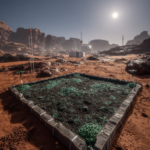
The nursery function encompasses several distinct production lines. Cyanobacterial inoculant is produced in bulk: liquid cultures of the species and strains that proved successful in Stage 6 are grown in bioreactors and packaged for distribution to expanding colonization zones. The volume required is substantial — each new hectare of surface to be colonized requires liters of concentrated inoculant, and the expansion is measured in hectares per Martian year as successful zones grow and new zones are established. Lichen propagules are cultivated in climate-controlled chambers where temperature, humidity, and light conditions mimic the outdoor target zones. Lichens grow slowly even under optimal conditions; the nursery must maintain years-long production cycles to supply the outdoor introduction program. Moss colonies are cultivated on trays of Mars regolith simulant under progressively hardened conditions, gradually reducing atmospheric pressure, increasing UV exposure, widening temperature swings, and reducing irrigation to produce populations adapted to outdoor survival. The hardening process is itself a selection experiment: the individuals that survive the most Mars-like nursery conditions are the ones transplanted outside.
Critically, the nurseries also produce mycorrhizal inoculum. AM fungal spores and colonized root fragments are cultivated in association with host plants growing in regolith substrate. When seedlings destined for outdoor transplant have developed healthy root systems with established mycorrhizal colonization, they are transplanted as complete plant-fungus units. The nursery does not merely produce organisms — it produces partnerships, pre-assembled and tested before deployment to the field.
6.3 Acclimation and Selection
The nurseries serve as transition chambers between Earth-origin biology and Mars-surface reality. Organisms arrive in the greenhouse from Earth-origin genetic stocks that have been maintained under terrestrial conditions. They cannot be placed directly outdoors. The acclimation protocol subjects each species to a graduated series of environmental changes: atmospheric composition is shifted from the greenhouse’s controlled mix toward Martian ratios, pressure is reduced in stages, temperature range is widened, UV exposure is introduced and increased, and irrigation is reduced toward the levels available outdoors. At each stage, the population is assessed for viability. Individuals or subpopulations that fail to acclimate are replaced. Those that survive are advanced to the next stage. The process produces populations that are not identical to their Earth-origin ancestors — they are selected, hardened, and in some cases genetically shifted by the selection pressure of increasingly Mars-like conditions. Over generations of greenhouse cultivation under these conditions, the nursery populations become progressively more Mars-adapted. This is not genetic engineering. It is directed natural selection, applied with purpose and patience.
7. Managing the Expansion
7.1 Expansion Strategy
Stage 7’s expansion is not a single front advancing uniformly across the Martian surface. It is a mosaic — multiple colonization zones at different stages of development, in different locations, expanding at different rates determined by local conditions. Some zones will be in the cyanobacterial biocrust phase. Others, established earlier or in more favorable locations, will have progressed to lichen colonization. A few, in the most protected and well-supplied locations, may have reached the moss establishment phase. The expansion strategy prioritizes depth over breadth: it is more valuable to bring a small area through the full succession sequence to the point of supporting vascular plants than to spread thin cyanobacterial biocrusts across vast areas that never advance beyond the pioneer stage.
New colonization zones are established adjacent to successful existing zones, following the principle that biology spreads most reliably from areas where it is already established. The edge of an active biocrust is a better inoculation source than greenhouse-produced culture, because the edge organisms have already demonstrated outdoor survival in local conditions. Where possible, expansion is achieved by removing barriers and allowing existing biological fronts to advance naturally, supplemented by targeted inoculation of new areas that are beyond natural dispersal range. Water infrastructure from Stage 5 is extended to new zones as they are established, and monitoring systems from Stage 6’s architecture are deployed to track each zone’s progress through the succession sequence.
7.2 Oxygen as a Metric
Among all the outputs of Stage 7’s biological colonization, oxygen is the one most directly relevant to the long-term habitability of Mars. Every mole of CO₂ fixed by photosynthesis releases one mole of O₂. On Earth, cyanobacteria required hundreds of millions of years to oxygenate the atmosphere because the planet’s initial oxygen sinks — dissolved ferrous iron in the oceans, reduced minerals in the crust — were enormous. On Mars, the situation is different: the surface is already heavily oxidized (the iron is already Fe₂O₃, not FeO), which means fewer chemical sinks are available to consume biologically produced oxygen. The Martian atmosphere is, in chemical terms, more receptive to free oxygen accumulation than Earth’s pre-GOE atmosphere was. However, the Martian atmosphere is also vastly larger by mass than the biological oxygen production of Stage 7’s colonization zones. The oxygen contribution from Stage 7 will be locally measurable — detectable above active biocrust zones — but globally negligible for decades or centuries. It is a signal, not yet a transformation. The transformation comes later, when the colonized surface area has grown from hectares to thousands of square kilometers, but it begins here, with the first cyanobacterial photon captured and the first O₂ molecule released on an open Martian surface.
7.3 Soil Quality Metrics
The success of Stage 7 is measured not primarily by the area colonized but by the quality of the soil produced. Five metrics define soil quality in the colonization zones. First, organic carbon content: the percentage of soil mass composed of organic matter. Raw Martian regolith contains effectively zero organic carbon. Biocrust-colonized soil should show measurable and increasing organic carbon over time. Second, nitrogen content: bioavailable nitrogen (ammonium, nitrate) in the soil, produced by cyanobacterial nitrogen fixation and organic matter decomposition. Third, water-holding capacity: the mass of water retained per mass of soil after drainage. Raw regolith holds very little water; EPS-amended, organic-enriched soil holds substantially more. Fourth, particle aggregation: the physical structure of the soil, measured by the stability of soil aggregates when wetted. EPS binding and fungal hyphae create aggregates that resist erosion. Fifth, microbial biomass: the total living biological mass in the soil per unit area, measured by DNA extraction or phospholipid fatty acid analysis. Increasing microbial biomass indicates a soil ecosystem that is growing, diversifying, and becoming self-sustaining.
8. Continuity with All Prior Stages
Stage 7 is the stage where the cumulative nature of the Mars Habitat Project becomes most visible. Every prior stage is actively contributing to the conditions that make biological expansion possible. Stage 1’s robotic instruments continue monitoring global and regional environmental conditions, providing the data context for interpreting colonization results and selecting new expansion sites. Stage 2’s magnetic shielding infrastructure continues protecting the settlement and its immediate environs from the most energetic solar particle events. Stage 3’s greenhouses now function as nurseries, but they also continue producing food and serving as controlled-environment research facilities — testing new species combinations, optimizing inoculant production, and maintaining the genetic repository that backstops every outdoor introduction. Stage 4’s atmospheric engineering continues thickening the atmosphere, and each increment of pressure provides more UV shielding, more thermal buffering, longer daily windows of liquid water stability, and higher partial pressures of CO₂ and N₂ for photosynthesis and nitrogen fixation. Stage 5’s water liberation continues expanding the liquid water available for irrigation and the hydrological activity that moistens the subsurface. Stage 6’s test zone infrastructure continues operating in its original bounded zones, now serving as long-term ecological monitoring sites and reference benchmarks for the expanding colonization.
No stage is finished. No stage is replaced. The entire framework operates as a concurrent system in which earlier stages create and maintain the conditions that later stages require. Stage 7’s expanding biology is simultaneously the beneficiary and the collaborator of every stage that preceded it: it benefits from the thicker atmosphere, the available water, the reduced soil toxicity, and the knowledge accumulated in the greenhouses. And it contributes back: the oxygen produced by photosynthesis, however small in quantity, slightly thickens the atmosphere that Stage 4 is building. The soil organic matter produced by biological colonization improves the water retention that makes Stage 5’s water more useful. The biocrusts that stabilize the surface reduce the dust loading that can attenuate solar radiation reaching Stage 4’s atmospheric engineering inputs. The stages are not linear. They are a web, and Stage 7 is the stage where that web becomes most densely interconnected.
9. Discussion
Stage 7 is where the Mars Habitat Project stops being an engineering program and starts being an ecological one. The distinction matters. Engineering programs build things according to specifications. Ecological programs create conditions and then observe what living systems do with them. The expansion of biology beyond Stage 6’s bounded test zones introduces a fundamental shift in the locus of control: the organisms are no longer doing exactly what humans tell them to do. They are reproducing, spreading, competing, cooperating, dying, and adapting in ways that are influenced by human management but not determined by it. The biocrust does not know its boundary. The lichen does not consult the expansion schedule. The fungal hypha follows nutrient gradients and moisture, not mission parameters. Stage 7 is the stage where the project’s success depends on its ability to work with biological systems rather than commanding them.
The analogy to Earth’s history is informative but imperfect. On Earth, cyanobacteria terraformed the planet without any intention or management. They simply photosynthesized, and the consequences accumulated over billions of years. On Mars, the process is deliberately initiated, actively managed, and dramatically accelerated by the engineered conditions of prior stages: the thicker atmosphere, the liquid water, the remediated soil, the UV shield. The cyanobacteria on Mars are doing the same chemistry as their ancestors on early Earth, but they are doing it on a surface that has been prepared for them, under an atmosphere that is being built around them, with water that is being delivered to them. The question is whether the same fundamental biology — photosynthesis, nitrogen fixation, EPS secretion, soil building — can produce the same fundamental transformation under these managed conditions. Stage 7 is the experiment that answers that question.
There will be failures. Zones where biocrusts refuse to establish despite repeated inoculation. Lichens that survive one Martian winter but not two. Mosses that desiccate irreversibly during dust storm season. Fungal networks that fail to establish in soils with insufficient organic carbon. These failures are not reasons to stop. They are the data that refines the approach. The succession sequence described in this paper is a template, not a guarantee. The actual sequence on Mars will be modified by every failure and every success, shaped by the specific conditions of each zone, each year, each organism. What will not change is the fundamental strategy: let biology build from the bottom up, one succession stage at a time, each stage creating the conditions for the next, with patience measured in decades and ambition measured in planetary scales.
10. Conclusion
Stage 7 of the Mars Habitat Project expands biology from the bounded test zones of Stage 6 onto the open Martian surface at landscape scale. Cyanobacteria — the same organisms that transformed Earth’s atmosphere during the Great Oxidation Event 2.4 billion years ago — colonize prepared surfaces, photosynthesizing, producing oxygen, fixing nitrogen, and building biological soil crusts that convert sterile regolith into living soil. Lichens follow in zones where biocrusts have matured, accelerating mineral weathering and deepening the organic layer. Mosses establish where conditions are most favorable, increasing soil depth and water retention. Below the surface, fungal hyphae begin forming the mycorrhizal networks that will eventually connect the roots of vascular plants into cooperative nutrient-sharing systems. The greenhouses of Stage 3, operating since the earliest human presence on Mars, now function primarily as nurseries — propagating, acclimating, and deploying the organisms that are colonizing the planet.
The process is deliberate. The process is slow. The process mirrors the primary ecological succession that has colonized bare mineral substrates on Earth for hundreds of millions of years. It proceeds from simple to complex, from microbe to plant, from surface to subsurface, from isolated individual to connected network. Each stage of succession depends on the stage that preceded it. Each stage modifies the environment in ways that make the next stage possible. The pace is set by biology, not by schedule. Human management creates conditions, prepares surfaces, supplies water, deploys organisms, and monitors results. The organisms do the rest.
If Stage 7 succeeds — if biocrusts spread, if lichens establish, if mosses deepen the soil, if fungal networks form, if the expanding biological surface begins to feed back positively into Stage 4’s atmospheric changes — then Mars is no longer a planet on which life survives inside enclosures. It is a planet on which life is growing, spreading, and transforming the surface. The next stages of this framework describe how that transformation continues: from primitive plant colonization to complex ecosystems, from managed expansion to self-sustaining biomes. But those later stages depend entirely on what happens here, in the cyanobacterial crust spreading across the regolith, in the lichen thallus weathering mineral grain, in the moss cushion trapping dust and moisture, in the fungal hypha threading through the darkness underground. Stage 7 is where Mars begins to become alive.
References
Billi, D. et al. (2021). Exploiting a perchlorate-tolerant desert cyanobacterium to support bacterial growth for in situ resource utilization on Mars. International Journal of Astrobiology, 20, 29–35.
Frew, A. et al. (2025). Mycorrhizal networks: Understanding hidden complexity. Functional Ecology, 39(7).
Grettenberger, C.L. et al. (2025). Distribution of early-branching Cyanobacteriia and the potential habitats that gave rise to the earliest oxygenic phototrophs. mSphere, 10(2).
Horne, J.E. & Goldblatt, C. (2025). An early origin of oxygenic photosynthesis delays the Great Oxidation. Philosophical Transactions of the Royal Society B, 380(1931).
Kasiviswanathan, P. et al. (2022). Farming on Mars: Treatment of basaltic regolith soil and briny water simulants sustains plant growth. PLoS ONE, 17(8), e0272209.
Khoshtinat, S. et al. (2025). From Earth to Mars: A perspective on exploiting biomineralization for Martian construction. Frontiers in Microbiology, 16.
Lehmann, A. et al. (2025). Meta-analysis of effects of common mycorrhizal networks formed by arbuscular mycorrhizal fungi. Functional Ecology, 39(13).
Macario, I.P.E. et al. (2025). Survival of filamentous cyanobacteria through Martian ISRU: Combined effects of desiccation and UV-B radiation. Microorganisms, 13(5), 1083.
Martinez-Luaces, V. et al. (2025). Ultraviolet and biological effective dose observations at Gale Crater, Mars. Proceedings of the National Academy of Sciences.
Olejarz, J. et al. (2021). The Great Oxygenation Event as a consequence of ecological dynamics modulated by planetary change. Nature Communications, 12, 3985.
Rillig, M.C. et al. (2025). A hierarchical reconceptualisation of common mycorrhizal networks. Functional Ecology, 39(7).
Rosado, A.S. et al. (2025). The role of extremophile microbiomes in terraforming Mars. Communications Biology, 8, 1588.
Santos, M.V. et al. (2025). Cyanobacteria and soil restoration: Bridging molecular insights with practical solutions. Microorganisms, 13(7), 1468.
Skubała, K. et al. (2025). Ionizing radiation resilience: How metabolically active lichens endure exposure to the simulated Mars atmosphere. IMA Fungus, 16.
Schimel, J.P. (2018). Life in dry soils: Effects of drought on soil microbial communities and processes. Annual Review of Ecology, Evolution, and Systematics, 49, 409–432.
Verseux, C. et al. (2021). Sustainable use of Mars resources for cyanobacterium-based life support. Frontiers in Microbiology, 12, 611798.
Wamelink, G.W.W. et al. (2014). Can plants grow on Mars and the Moon: A growth experiment on Mars and Moon soil simulants. PLoS ONE, 9(8), e103138.
Xiao, B. et al. (2024). Cyanobacterial filament network structures and soil stabilization. Soil Biology and Biochemistry.