A White Paper on the Completion of Planetary Terraforming
and the Beginning of Habitation Without Enclosure
———————————————
Breathable Atmosphere, Natural Water Cycle, Agricultural Soil,
Self-Sustaining Ecosystems, and the End of Living Inside
Abstract
This paper describes the tenth and final stage of the Mars Habitat Project’s terraforming framework: open habitation. The atmosphere is breathable. Not Earth-normal — thinner, cooler, with a different gas ratio — but breathable: sufficient oxygen partial pressure for sustained human respiration without supplemental equipment, sufficient total pressure to eliminate the need for pressure garments, and a mature ozone layer that reduces surface ultraviolet radiation to levels compatible with unprotected human skin exposure. Water cycles naturally: precipitation falls from clouds formed by biological transpiration and surface evaporation, flows across the surface in streams and seasonal rivers, percolates through soil into subsurface aquifers, and is drawn back up by plant roots to transpire into the atmosphere again.
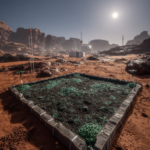
Soil supports agriculture: decades of organic matter accumulation, nutrient cycling by decomposer communities, mycorrhizal network development, and earthworm engineering have produced soils deep enough, fertile enough, and biologically active enough to grow food crops outdoors without the controlled environment of a greenhouse.
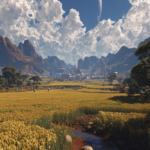
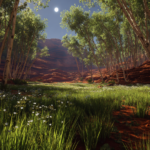
Ecosystems are self-sustaining: food webs regulate themselves through predator-prey dynamics, decomposer communities recycle nutrients without human management, plant communities reproduce sexually through pollinator interactions, and the system absorbs and recovers from perturbation — drought, dust storms, population fluctuations — without collapsing. Humans live on Mars. Not in a box on Mars. Not in a pressurized habitat visiting the surface through an airlock.
On Mars. Outside. In the air, in the weather, in the landscape. The greenhouses that started as survival shelters in Stage 3, evolved into research laboratories through Stages 4 and 5, became nurseries in Stages 7 and 8, and served their last operational purpose in Stage 9 are now historical monuments — preserved structures that tell the story of how a species arrived on a dead planet and made it alive. This paper describes the conditions that define open habitation, the atmospheric and ecological thresholds that must be met, the transition of human settlement patterns from enclosed to open architecture, the agricultural capacity of Martian soil, the self-sustaining dynamics of the mature ecosystem, the fate of the original infrastructure, and the meaning of what has been accomplished.
1. Introduction
1.1 The Arc of the Framework
The Mars Habitat Project began with robots and instruments on a dead surface. Stage 1 measured the planet. Stage 2 established human presence under shielding. Stage 3 built greenhouses — sealed glass rooms where Earth biology could survive on a world that would kill it. Stage 4 began thickening the atmosphere. Stage 5 liberated water. Stage 6 opened the greenhouse door and tested biology against the real surface in bounded zones. Stage 7 expanded microbes and primitive plants across the open landscape. Stage 8 introduced vascular plants — grasses, legumes, trees — and began building real soil. Stage 9 added animals, completed food webs, and watched weather and ozone emerge from the biological activity of the surface. Each stage built on the one before it. Each stage created conditions that the next stage required. Each stage was governed by the same principle: you do not scale what you have not proven. The proof accumulated. The conditions improved. The biology expanded. The atmosphere thickened. The ozone formed. The water cycled. And at some point — not on a single day, not by a single decree, but through the gradual, compounding, irreversible accumulation of biological and atmospheric change — the planet crossed a threshold. The threshold is Stage 10. The planet is habitable. Humans can live outside.
1.2 What “Open Habitation” Means
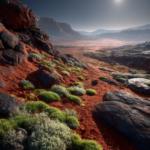
Open habitation does not mean that Mars has become Earth. It has not. Mars is smaller, colder, further from the sun, and possessed of a gravity field 38 percent of Earth’s. Its day is 37 minutes longer. Its year is 687 Earth days. Its axial tilt produces seasons, but those seasons operate on a different calendar with different thermal inertia. Its atmosphere, even fully terraformed, will differ from Earth’s in composition, pressure, and optical properties. Its ecosystems, built from organisms selected and acclimated over generations, will not replicate any terrestrial biome. Mars in Stage 10 is not a copy of Earth. It is Mars — a second living world, the first one humans have made, operating on its own terms with its own biology and its own character. Open habitation means that a human being can walk out of a building, breathe the air, feel the weather, work the soil, eat food grown in that soil, drink water that fell from the sky, and sleep under a roof that is not pressurized. It means that survival does not depend on a sealed envelope of engineered atmosphere. It means that Mars is home, not in the metaphorical sense of a place where humans have decided to stay, but in the biological sense of a place where a human body can function without life support.
2. The Breathable Atmosphere
2.1 What Breathable Requires
Human respiration requires oxygen partial pressure above approximately 60 millibars for sustained activity at moderate exertion, and above approximately 100 millibars for full exertion equivalent to sea-level performance. Earth’s sea-level oxygen partial pressure is 213 millibars (21 percent of 1013 millibars total pressure). Stage 10 does not require Earth-equivalent oxygen. It requires enough. The target is an atmosphere with total surface pressure between 300 and 500 millibars — equivalent to terrestrial elevations of approximately 5,000 to 8,000 meters, altitudes at which millions of people live and work permanently on Earth (La Paz, Lhasa, Cusco, and thousands of other high-altitude communities). Within this pressure envelope, an oxygen fraction of 20 to 35 percent provides oxygen partial pressures of 60 to 175 millibars — the range between tolerable and comfortable. The remaining atmospheric composition is primarily nitrogen (derived from Stage 4’s volatile release and biological nitrogen cycling) and carbon dioxide (the original Martian atmospheric component, now reduced from its initial dominance by biological fixation and diluted by the addition of oxygen and nitrogen). Trace gases include argon (primordial), water vapor (from the active hydrological cycle), and the ozone that forms from oxygen photolysis.
2.2 How the Atmosphere Reached This State
The atmosphere of Stage 10 was built by nine stages of concurrent effort. Stage 4’s atmospheric engineering released trapped volatiles — CO₂ from polar caps and regolith, N₂ from nitrate minerals — and introduced greenhouse gases that warmed the surface and prevented atmospheric freeze-out. Stage 5’s water liberation supplied the moisture that entered the atmosphere as vapor. Stages 7, 8, and 9’s biological colonization fixed carbon from CO₂ into organic matter and released O₂, gradually shifting the atmospheric composition from nearly pure CO₂ toward a mixed atmosphere. The biological oxygen contribution compounded over decades and centuries: each generation of plant growth fixed carbon, some of which was buried in deepening soils, and the corresponding oxygen accumulated in the atmosphere. The nitrogen fraction increased through both volcanic/mineral release and biological nitrogen cycling (nitrogen fixed by cyanobacteria and legumes entered the soil, was mineralized by decomposers, denitrified by bacteria, and returned to the atmosphere as N₂ in a cycle that gradually enriched the atmospheric nitrogen pool). The result is an atmosphere that is neither the original Martian CO₂ envelope nor a replica of Earth’s N₂/O₂ mix, but something new: a biological atmosphere, built by the interaction of engineered volatile release and billions of organisms photosynthesizing, respiring, fixing, and cycling gases over the timescale of the framework.
2.3 The Ozone Shield Complete
The ozone layer that began forming in Stage 9 has, by Stage 10, matured to a column density sufficient to reduce surface UVB radiation to levels comparable to high-altitude terrestrial locations. UVC — the most biologically destructive wavelength range, which has irradiated the Martian surface unimpeded for billions of years — is now almost entirely absorbed before reaching the ground. The ozone shield is self-maintaining: it is produced continuously by the photolysis of the biological oxygen that the surface ecosystem produces continuously. As long as the ecosystem produces oxygen, the ozone layer persists. If oxygen production were to cease entirely — if all biology on the surface died simultaneously — the ozone layer would degrade over years to decades as existing O₃ was destroyed by photochemical reactions without being replenished. But this scenario is precisely what Stage 10’s self-sustaining ecosystem prevents: the ecosystem that produces the ozone is the same ecosystem that the ozone protects, and neither can collapse without the other collapsing first. The feedback loop is stable. The shield holds because the biology holds, and the biology holds because the shield holds. This is not engineered redundancy. It is the same coupled stability that has maintained Earth’s ozone layer for two billion years.
3. The Natural Water Cycle
3.1 A Closed Hydrological System
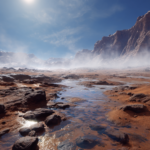
In Stage 5, water was liberated — melted from subsurface ice, extracted from hydrated minerals, collected from atmospheric processing. It was a resource, managed and distributed by engineered systems: pipes, pumps, reservoirs, irrigation schedules. In Stage 10, water is a cycle. Precipitation falls from clouds onto vegetated surfaces and bare ground. Some is intercepted by plant canopy and evaporates. Some reaches the soil surface and infiltrates, drawn downward by gravity through the pore spaces and root channels of the soil profile until it reaches saturated zones — subsurface aquifers recharged by the percolation of surface water. Some flows across the surface as runoff, collecting in depressions, channels, and eventually streams — the first flowing surface water on Mars in three billion years. Plants draw water from the soil through their roots and transpire it from their leaves, returning it to the atmosphere. Surface water bodies evaporate. Atmospheric moisture condenses into clouds. Clouds precipitate. The cycle repeats.
This cycle is not yet as vigorous as Earth’s. Mars receives less solar energy, its atmosphere holds less total moisture, and its lower gravity allows water vapor to distribute more broadly through the atmospheric column. Precipitation is lighter and less frequent than on most of Earth’s surface. Many regions remain arid, receiving moisture primarily from fog and dew rather than rain. Seasonal variation is pronounced: the warm season produces more transpiration, more atmospheric moisture, more cloud formation, and more precipitation; the cold season reduces all of these, and water storage shifts from atmospheric and surface forms to subsurface ice and snowpack. But the system is closed. Water is not being delivered from an engineered source. It is cycling through the planet’s atmosphere, surface, soil, biosphere, and subsurface under the same physical laws that drive the hydrological cycle on Earth. The infrastructure of Stage 5 — the pumps, the pipes, the reservoirs — still exists, and some of it still operates to supplement natural precipitation in the driest agricultural zones. But the system no longer depends on it. If every pump stopped, the water cycle would continue. The planet waters itself.
3.2 Streams, Lakes, and Aquifers
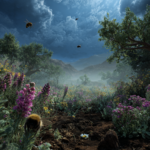
The first permanent surface water features on Mars since the Hesperian epoch are among the most visible markers of Stage 10. Streams form where precipitation and snowmelt collect in topographic channels, flowing downslope through vegetated valleys. Their flow is seasonal — strongest in the warm season when snowmelt and transpiration-driven precipitation are highest, diminishing or freezing in the cold season. Where streams converge or where topography creates enclosed basins, lakes form. These are not large bodies by terrestrial standards — ponds and small lakes, hectares rather than square kilometers — but they are persistent, fed by precipitation and groundwater discharge, fringed by vegetation adapted to wet soils, inhabited by the aquatic and semi-aquatic invertebrates introduced in Stage 9. Below the surface, aquifers develop in permeable regolith layers, recharged by precipitation percolation, and discharged through springs and seeps that feed surface streams during dry periods. The presence of permanent surface water completes the hydrological system and creates new habitat types — wetlands, riparian corridors, shoreline communities — that support biological diversity far exceeding what dryland ecosystems alone can sustain.
4. Soil That Feeds People
4.1 From Regolith to Farmland
The soil of Stage 10 is the accumulated product of every biological stage that preceded it. Cyanobacteria fixed the first carbon and nitrogen into sterile basalt. Lichens weathered minerals. Mosses deepened the organic layer. Grass roots bound and structured the substrate. Legume nodules pumped nitrogen. Tree roots drove organic matter to depth. Earthworms mixed, aerated, and enriched the profile. Decomposer communities recycled generations of dead biomass into humic compounds. Mycorrhizal networks connected the root systems of the plant community into nutrient-sharing cooperatives. The result, in zones where the full succession sequence has operated for decades to centuries, is soil that a terrestrial agronomist would recognize: structured into stable aggregates, dark with organic matter in the topsoil, grading to lighter mineral subsoil below, penetrated by roots and worm burrows, moist from natural precipitation and capillary rise, cycling nitrogen, phosphorus, and potassium through biological pathways, and supporting microbial biomass densities comparable to productive terrestrial grassland soils. This is farmland. Not amended, irrigated, fertilized, temperature-controlled greenhouse substrate. Farmland. Soil that a seed can be placed into and, given water from the sky and light from the sun, will produce food.
4.2 What Can Be Grown
The crops of Stage 10 are the descendants of plants that have been cultivated on Mars since Stage 3 — populations that have been selected through hundreds of generations under Martian gravity, photoperiod, light spectrum, temperature range, and atmospheric composition. They are not identical to their Earth ancestors. They have been shaped by their environment, selected for traits that make them productive under conditions that would stress or kill unacclimated terrestrial varieties: shorter growing seasons, lower light intensity, cooler temperatures, higher UV even with the ozone shield, and the specific nutrient profile of Martian soil. Grains (wheat, rye, barley), legumes (beans, lentils, peas, alfalfa), root vegetables (potatoes, turnips, radishes, carrots), leafy greens (lettuce, spinach, kale), and brassicas (cabbage, broccoli) have all been cultivated in the greenhouses and outdoor zones through the preceding stages. The varieties that perform best outdoors in Stage 10’s open agricultural zones are the varieties selected by Mars itself — the offspring of the individuals that survived and produced the most under the real conditions of the real Martian surface, not the optimized conditions of a greenhouse.
4.3 Agriculture Without Greenhouses
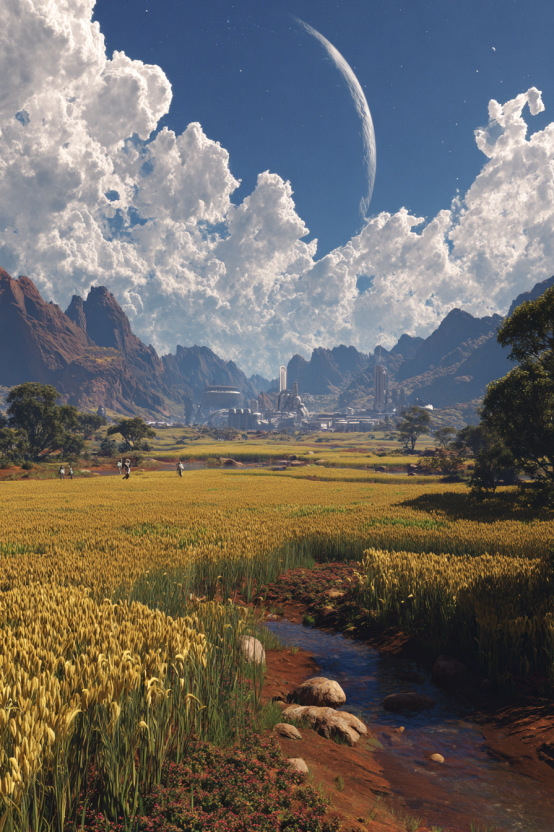
The defining agricultural achievement of Stage 10 is that food production no longer requires a greenhouse. Seeds are sown into outdoor soil, irrigated by rain and supplemental systems where needed, pollinated by bees and wind, and harvested by hand or machine. Crop residues are returned to the soil or composted, feeding the decomposer community that recycles their nutrients for the next season’s growth. Legume rotations maintain soil nitrogen. Cover crops protect the soil surface from erosion during fallow periods. Mycorrhizal networks, established through years of continuous plant cover, persist in the soil between crops and colonize new plantings within days of germination. The agricultural system is, in its fundamental operations, indistinguishable from low-input agriculture on Earth: biology produces food from soil, water, air, and sunlight, and the waste products of that production feed the biological systems that make the next cycle of production possible. The greenhouses still exist. Some continue operating as controlled-environment research facilities, testing new crop varieties, breeding ornamental species, or producing specialty crops that require conditions the outdoor environment cannot provide. But the settlement’s food security no longer depends on them. If every greenhouse on Mars failed simultaneously, the population would eat. They would eat food grown outside, in soil built by the biology they introduced, watered by rain that fell from clouds that plants made, under a sky that cyanobacteria oxygenated. The food chain rests on the planet, not on the infrastructure.
5. Self-Sustaining Ecosystems
5.1 What Self-Sustaining Means
An ecosystem is self-sustaining when it persists and functions without continuous human management. This does not mean it is unaffected by humans — humans are part of the ecosystem, and their activities (agriculture, construction, movement, waste production) influence every community they inhabit. It means that the ecosystem’s core processes — primary production, nutrient cycling, decomposition, population regulation, reproduction, and succession — operate through their own internal dynamics rather than through human engineering. Plants photosynthesize because the sun shines and the atmosphere contains CO₂, not because a greenhouse regulates their light and gas supply. Nutrients cycle because decomposers break down dead material and plants take up the released minerals, not because humans apply fertilizer. Populations are regulated because predators eat prey, competitors partition resources, and diseases limit overpopulation, not because humans cull or supplement. Reproduction occurs because pollinators visit flowers, seeds disperse on wind and in animal guts, and seedlings establish in the gaps left by dying adults, not because humans propagate and transplant. The system runs itself. Humans participate in it as one species among many, disproportionately influential because of their intelligence and technology, but no longer the system’s sole sustainer.
5.2 Ecological Resilience
Self-sustaining does not mean fragile equilibrium. It means resilience — the capacity to absorb disturbance and return to functional operation. Mars will continue to experience dust storms, solar particle events, seasonal temperature extremes, drought, and the unpredictable dynamics of a young, still-evolving planetary climate. The ecosystems of Stage 10 must survive these perturbations, and they must do so without human intervention restoring every damaged component. Resilience comes from diversity and redundancy: multiple species performing similar ecological functions, so that the loss of one is compensated by the expansion of others. If one pollinator species crashes during a cold season, other pollinator species fill the gap. If one grass species fails during drought, other drought-tolerant grasses maintain the soil cover. If a predator population declines, other predators or other regulatory mechanisms (disease, resource limitation) prevent herbivore outbreak. The ecosystems introduced through Stages 7, 8, and 9 were deliberately assembled with this redundancy in mind: multiple species per functional role, multiple trophic pathways per energy flow, multiple nutrient cycling routes per element. The result is a system that bends under stress rather than breaking — populations shift, species compositions change, community structure adjusts, but the core functions persist. The soil holds. The nutrients cycle. The water moves. The oxygen flows. The system absorbs the blow and recovers.
5.3 Evolution Begins
Stage 10 marks the beginning of something that no human intervention can control or fully predict: evolution. Every organism on the Martian surface is reproducing, and every reproduction event involves the potential for genetic variation — mutation, recombination, selection. The selection pressures on Mars are different from those on Earth: different gravity, different radiation spectrum, different atmospheric composition, different temperature regime, different soil chemistry, different day length, different seasonal pattern. Over generations — fast generations for microbes and insects, slower generations for plants and vertebrates — the Martian populations will diverge from their Earth ancestors. New traits will be selected. New adaptations will emerge. Eventually, new species will arise — organisms that have never existed on Earth, shaped by a selective environment that has never existed before, occupying ecological niches that are uniquely Martian. This is not a planned outcome. It is an inevitable consequence of placing reproducing organisms in a novel environment and allowing time to pass. The Mars Habitat Project introduces the founding populations. Evolution takes them from there. In a thousand years, ten thousand years, the biosphere of Mars will contain organisms that no human designed and no Earth ecosystem produced. Life, once established, makes its own decisions.
6. Human Life on an Open Mars
6.1 Architecture Without Pressure
The buildings of Stage 10 do not need to hold pressure. This single fact transforms every aspect of human architecture on Mars. In Stages 2 through 9, every structure inhabited by humans was an airtight vessel: welded metal or reinforced composite, sealed against the near-vacuum outside, equipped with airlocks, pressure regulation systems, atmospheric scrubbers, and emergency containment. Buildings were heavy, expensive, limited in size by the engineering constraints of pressure containment, and psychologically oppressive in their sealed, windowless necessity. In Stage 10, a building is a building. It has walls because walls block wind and retain heat. It has a roof because roofs keep out rain and snow. It has windows because windows let in light and air. It has doors that open directly to the outside, because the outside is survivable. Construction materials include locally quarried stone, locally fired brick, locally milled timber from the forests that Stage 8 planted and Stage 9 grew to maturity. Buildings can be any size, any shape, any style. They can have gardens. They can have porches. They can have open courtyards. For the first time in the history of human habitation on Mars, architecture serves human comfort and culture rather than human survival.
6.2 Living Outdoors
Humans in Stage 10 live outdoors in the way that humans have lived outdoors for the entire history of the species on Earth. They walk between buildings without suiting up. They work in fields and gardens in clothing appropriate to the weather — warm layers in the cold season, lighter wear in the warm season. They eat meals outside. Children play outside. Communities gather in open-air spaces. The thin Martian air carries sound differently than Earth’s — voices carry less far, wind sounds different through leaves, rain falls more quietly in the lower gravity — but it carries sound, and the landscape is not the silent vacuum of the early stages. Birds call. Insects hum. Wind moves through grass. Water runs over rock. These are the sounds of a living planet, and they are the ambient background of daily life on Mars. The human body adapts to the conditions: lower gravity means less cardiovascular strain and different musculoskeletal loading. Lower atmospheric pressure means slightly faster breathing at rest and reduced maximum aerobic capacity compared to Earth sea level, comparable to living at 3,000 to 4,000 meters on Earth — challenging but fully tolerable for acclimated individuals, as demonstrated by millions of permanent residents at equivalent altitudes on Earth. Skin pigmentation and UV tolerance may shift over generations in response to the residual UV environment, just as they shifted among human populations on Earth in response to different latitudes and UV exposures.
6.3 A Martian Culture
A species that lives on a planet develops a culture shaped by that planet. The humans of Stage 10 are Martian in a way that the settlers of Stage 2 were not. Their calendar follows the Martian year. Their agriculture follows Martian seasons. Their architecture reflects Martian weather and Martian materials. Their diet is shaped by what Martian soil produces. Their aesthetic sense is formed by Martian landscapes: red rock and green vegetation, thin blue sky, two small moons, unfamiliar constellations. Their children are born on Mars, grow up on Mars, and understand Earth as a place of origin — important, ancestral, connected by communication and trade and shared genetic heritage, but not home. Home is here: the soil under their feet, the air in their lungs, the water in their streams, the forests and fields and communities they live in. This cultural shift is not engineered. It is the inevitable consequence of generations of human life on a world that has become habitable enough to be lived in rather than merely survived on. Culture follows ecology. When the planet is alive, the people who live on it develop a relationship with it that is more than operational. It becomes emotional, aesthetic, spiritual — the full range of human response to the natural world, directed at a natural world that their ancestors made.
7. The Greenhouses: From Survival to Monument
7.1 The Full Arc
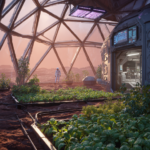
The greenhouses of Stage 3 were the most important structures ever built on Mars. When they were sealed and pressurized and the first seeds germinated under artificial light in Martian regolith, they represented the entire biological foothold of Earth life on another planet. Everything outside those walls was dead. Everything inside was alive. The glass was the boundary between a dead world and the possibility of a living one. Through Stage 4 and Stage 5, the greenhouses served as laboratories: testing which organisms could grow on Martian substrate, which microbes could remediate perchlorate, which cyanobacteria could tolerate radiation, which crop varieties could feed the settlement. Through Stages 6 and 7, they served as staging grounds: preparing the biological material that was introduced to the outdoor test zones and expanded across the surface. Through Stages 8 and 9, they served as nurseries: breeding and acclimating the plants, fungi, pollinators, decomposers, and animals that were deployed into the growing outdoor ecosystems. Each transformation of purpose reflected the success of the one before it. The greenhouses became laboratories because the survival function was secured. They became staging grounds because the research function had identified viable organisms. They became nurseries because the outdoor biology had proven itself and needed more organisms faster than natural reproduction could supply them.
7.2 The Last Operational Function
The last operational function of the original greenhouses was served in Stage 9, when the final cohorts of animal species were bred, acclimated, and released into the outdoor ecosystems. Once those populations established self-sustaining dynamics — breeding, overwintering, dispersing, integrating into food webs without further human supplementation — the nursery function was complete. Some greenhouse structures were repurposed: converted to botanical gardens, community spaces, educational facilities, or research stations for controlled-environment experiments that required conditions different from the outdoor environment. Others were maintained in their original configuration as historical sites, their bioreactors and growth chambers and airlock systems preserved exactly as they were during the years when they were the only thing keeping biology alive on Mars.
7.3 Monuments
The decision to preserve the original greenhouses as monuments is not sentimental. It is pedagogical. Every generation born on Mars will grow up on a planet that is alive, that has weather, that has soil with worms and forests with birds and streams with water. They will have no lived experience of the dead Mars that their ancestors arrived on. The preserved greenhouses exist to teach them what it cost. The sealed chambers where the first crops grew in regolith that had to be washed free of perchlorate before anything could survive in it. The bioreactors where cyanobacterial cultures were grown in volumes measured in liters before they were measured in hectares. The acclimation chambers where the temperature was lowered one degree per week and the pressure was dropped one millibar per day and the UV was increased one percent per cycle, killing the organisms that could not adapt and selecting the ones that could. The airlocks through which the first outdoor test zone inoculants were carried, by hand, in sealed containers, to be placed on a surface that was trying to sterilize them. The monitoring stations where the first oxygen readings from an outdoor biocrust were recorded — parts per million, barely above background, but real, biological, photosynthetic oxygen produced on the open surface of Mars. These structures and the records they contain are the memory of what it took to make a dead world alive. They are the most important historical monuments on Mars, and possibly the most important historical monuments in the history of the human species.
8. What Was Accomplished
8.1 The Scope of the Achievement
A species evolved on one planet traveled to another planet, found it dead, and made it alive. The sentence is simple. The achievement is not. It required understanding the physics of atmospheres, the chemistry of soils, the biology of extremophiles, the ecology of succession, the engineering of closed-loop life support, and the patience to execute a plan measured in generations. It required building an atmosphere from trapped volatiles and biological gas exchange. It required liberating water from ice and minerals and establishing a self-sustaining hydrological cycle. It required taking sterile, toxic, ultraviolet-blasted mineral dust and converting it into soil — living, structured, fertile soil capable of growing food. It required introducing thousands of species in the correct sequence, managing their interactions through decades of ecological development, and then stepping back and letting them regulate themselves. It required building an ozone layer from scratch, molecule by molecule, from oxygen produced by organisms that were themselves vulnerable to the radiation the ozone would eventually block. It required doing all of this concurrently, with each stage supporting every other stage, in a web of interdependencies so complex that no single mind could hold it all at once. And it required doing it on a world 225 million kilometers from the only planet where any of these organisms had ever existed before.
8.2 What Earth Taught
Everything in this framework was learned on Earth. The Great Oxidation Event taught that cyanobacteria can transform an atmosphere. Primary ecological succession taught that biology colonizes bare rock in a predictable sequence. Soil science taught that organic matter, microorganisms, fungi, and invertebrates convert mineral substrate into fertile soil. Agricultural science taught that legumes fix nitrogen, mycorrhizae enhance nutrient uptake, and crop rotations maintain soil health. Atmospheric chemistry taught that oxygen produces ozone and ozone shields surfaces from UV. Hydrology taught that transpiration drives precipitation. Ecology taught that diverse food webs self-regulate. Every principle applied on Mars was discovered on Earth. The innovation was not in the principles. It was in the application: taking processes that operated naturally and unconsciously on one planet over billions of years and applying them deliberately, sequentially, and patiently on another. The framework did not invent terraforming. Earth’s biosphere invented terraforming. The framework merely noticed, learned, and repeated.
8.3 What Mars Taught
Mars taught things that Earth could not. It taught that life is robust enough to survive in a place that was never designed for it, if given the right support in the right sequence. It taught that the processes of soil formation and atmospheric transformation, which on Earth took billions of years, could be initiated on human timescales — not completed, but initiated, set in motion, given a trajectory that biology itself would sustain and accelerate. It taught that the difference between a dead planet and a living one is not fundamental physical constants or cosmic accidents — it is biology. The rock is the same: basalt, feldspar, olivine, iron oxide. The energy source is the same: solar radiation. The raw materials are the same: CO₂, N₂, H₂O, mineral nutrients. What Mars lacked was not physics or chemistry but biology. Once biology was introduced, the same processes that built Earth’s biosphere began building again. Slower, smaller, constrained by conditions less favorable than Earth’s — but building. The lesson of Mars is that a living planet is not a gift of fortune. It is a consequence of biology operating on available substrates under available energy, given enough time and, in this case, enough intention.
9. The Framework Complete
In Stage 10, the framework is complete. Not finished — the ecosystem will continue evolving, the atmosphere will continue maturing, the soils will continue deepening, the water cycle will continue intensifying, and the human community will continue adapting for centuries and millennia. But complete, in the sense that every element of the plan has been executed and every stage has achieved its purpose. The instruments of Stage 1 still operate, their data now part of a planetary monitoring system that tracks weather, ecosystem health, atmospheric composition, and geological activity. The shielding of Stage 2 is largely unnecessary — the atmosphere and ozone layer provide natural radiation protection — but the original structures remain as part of the settlement’s built heritage. Stage 3’s greenhouses stand as monuments. Stage 4’s atmospheric engineering has achieved its target and operates now in maintenance mode, monitoring atmospheric stability and adjusting inputs if needed to maintain pressure and composition within the habitable range. Stage 5’s water infrastructure supplements natural precipitation where needed but is no longer the primary water source. Stages 6, 7, 8, and 9’s biological introductions have produced a self-sustaining biosphere that no longer requires human supplementation to persist. The ten stages are not a sequence of tasks completed and set aside. They are layers of a system, each one still present, each one still functioning, each one essential to the whole. The planet is the system. The framework built it. Biology sustains it. Humans live in it.
10. Discussion
The question that every white paper in this framework has answered is: can this be done? The question that Stage 10 answers is different: it has been done. The distinction matters because the ten stages of this framework were, at the time of their original description, projections — informed by science, grounded in demonstrated principles, but projections nonetheless. Each stage paper described what would be attempted and why it should work. Stage 10 describes what has been achieved. The atmosphere is breathable because cyanobacteria, plants, and trees photosynthesized for long enough that the oxygen they produced exceeded the sinks that consumed it. The ozone layer exists because that oxygen, exposed to solar UV, undergoes the Chapman cycle. The water cycles because transpiring vegetation couples the surface water reservoir to the atmospheric moisture reservoir with enough energy to drive condensation and precipitation. The soil is fertile because generations of organisms lived, died, and were decomposed in it, leaving their molecular legacy as humic compounds, mineral nutrients, and stable aggregates. The ecosystems self-regulate because enough species were introduced, in the right sequence, with enough functional redundancy, that the emergent dynamics of competition, predation, mutualism, and decomposition produce stability without human management. None of these outcomes was guaranteed when Stage 1’s instruments first touched the Martian surface. All of them were possible, because all of them had already happened once, on Earth, without any plan at all.
The deepest lesson of the Mars Habitat Project is not technical. It is philosophical. A living planet is not an accident that happened once on one world and could never be replicated. A living planet is what biology does when it has the raw materials: rock, water, air, light. Earth proved this over four billion years of unconscious, undirected, stochingly patient biological activity. Mars proved it again, in a compressed timeframe, with deliberate intent, using the same biology, the same chemistry, the same physics. The universe is not hostile to life. It is indifferent. And indifference, it turns out, is enough. Given rock, water, air, and light, biology does the rest. It produces oxygen. It builds soil. It generates ozone. It cycles water. It creates food webs. It makes a planet habitable. It did it on Earth without being asked. It did it on Mars because it was asked. In both cases, the answer was the same: yes.
11. Conclusion
Stage 10 of the Mars Habitat Project is the end of terraforming and the beginning of habitation. The atmosphere is breathable. The water cycles naturally. The soil supports agriculture. The ecosystems are self-sustaining. Humans live on Mars — not in a pressurized box on Mars, but on Mars, in the air, in the weather, in the landscape, walking on soil that their ancestors made from dust. The greenhouses that were once the only living spaces on the planet are monuments now, preserved to remind future generations what the planet was before biology changed it and what it cost to make the change. The framework that accomplished this transformation was not a single grand invention. It was the patient, sequential, compounding application of principles that Earth’s biosphere discovered billions of years ago: photosynthesis produces oxygen, organic matter builds soil, transpiration drives weather, oxygen generates ozone, diversity creates resilience, and given enough time, biology transforms a planet. The Mars Habitat Project did not invent these principles. It borrowed them. It applied them to a world that had all the necessary raw materials and none of the necessary biology, and it waited while the biology did what biology does.
Mars is alive. Not as a metaphor. Not as a projection. Not as an aspiration. As a fact. A planet with soil and rain and forests and fields and insects and birds and streams and clouds and an ozone layer and people who walk outside and breathe. A second living world in a universe that, as far as anyone has yet determined, has produced only two. The first one happened by accident over four and a half billion years. The second one happened on purpose, because a species that evolved on the first one looked up at a red point of light in the night sky and decided it did not have to remain dead.
References
Chapman, S. (1930). A theory of upper atmospheric ozone. Memoirs of the Royal Meteorological Society, 3(26), 103–125.
Darwin, C. (1881). The Formation of Vegetable Mould Through the Action of Worms. John Murray, London.
Goldblatt, C. et al. (2006). Bistability of atmospheric oxygen and the Great Oxidation. Nature, 443, 683–686.
Kasting, J.F. (1987). Theoretical constraints on oxygen and carbon dioxide concentrations in the Precambrian atmosphere. Precambrian Research, 34, 205–229.
Makarieva, A.M. & Gorshkov, V.G. (2007). Biotic pump of atmospheric moisture as driver of the hydrological cycle on land. Hydrology and Earth System Sciences, 11, 1013–1033.
McKay, C.P. (1999). Bringing life to Mars. Scientific American Presents, 10(1), 52–57.
McKay, C.P. et al. (1991). Making Mars habitable. Nature, 352, 489–496.
Olejarz, J. et al. (2021). The Great Oxygenation Event as a consequence of ecological dynamics modulated by planetary change. Nature Communications, 12, 3985.
Sagan, C. (1973). Planetary engineering on Mars. Icarus, 20, 513–514.
Smith, S.E. & Read, D.J. (2008). Mycorrhizal Symbiosis, 3rd ed. Academic Press.
Wall, D.H. et al. (2012). Soil Ecology and Ecosystem Services. Oxford University Press.
Zubrin, R. & McKay, C.P. (1997). Technological requirements for terraforming Mars. Journal of the British Interplanetary Society, 50, 83–92.