A White Paper on the Critical Transition
from Greenhouse to Open Surface
———————————————
Soil Remediation, Perchlorate Bioremediation, UV-Hardened Organisms,
and the Principle That You Do Not Scale What You Have Not Proven
Abstract
This paper describes the sixth stage of the Mars Habitat Project’s terraforming framework: the establishment of controlled outdoor test zones — small, prepared patches of Martian surface adjacent to human settlements where biology meets the open Martian environment for the first time. Everything before this point has happened inside. Stage 3’s greenhouses proved that terrestrial organisms can grow in Martian regolith under controlled conditions.
Stage 5’s water liberation delivered liquid water to the surface for the first time since the Hesperian. Stage 6 is the moment those greenhouse lessons step outside. The zones are small by design. Soil in each test zone has been remediated through processes refined over decades of greenhouse research — perchlorate-reducing bacteria proven successful indoors are introduced to limited outdoor patches where they face actual Martian UV radiation, cosmic ray flux, temperature extremes, and atmospheric composition for the first time.
Monitoring is constant. If something fails, the zone is small and contained. The logic is deliberate: you do not scale what you have not proven. This paper reviews the specific hazards that outdoor Martian soil presents to biology (perchlorates, reactive oxygen species, UV sterilization, heavy metal mobilization), evaluates the organisms and remediation strategies developed in greenhouse settings, describes the design and monitoring architecture of the test zones themselves, and establishes the criteria by which a zone is judged successful enough to inform Stage 7’s expansion.
1. Introduction
1.1 The Greenhouse Wall
For every stage of the Mars Habitat Project up to this point, biology has operated behind glass. The greenhouses of Stage 3 — pressurized, heated, UV-filtered, atmospherically controlled — are the environments where terrestrial organisms first met Martian regolith and survived. Inside those structures, researchers learned to grow food in basaltic soil simulants, to reduce perchlorate contamination using dissimilatory bacteria, to build organic carbon content from zero using cyanobacterial biocrusts, and to maintain closed-loop nutrient cycling in an alien mineral substrate. Those lessons are real and hard-won. But the greenhouse wall also hides the truth about Mars. Inside the greenhouse, organisms never face the full ultraviolet flux that reaches the Martian surface. They never experience the diurnal temperature swings that can span more than 70 kelvin in a single sol. They never encounter the unfiltered cosmic ray environment that deposits roughly 0.77 gray per year into unshielded surface material. The greenhouse is not Mars. It is a version of Mars with the most dangerous variables removed.
Stage 6 removes the wall. Not everywhere — not yet. But in small, bounded, deliberately selected patches of Martian surface, organisms that proved themselves inside are placed outside to face the actual planet. This is the critical transition. If biology cannot survive and function in the open Martian environment, then everything that follows in this framework — expanded biomes, open-air ecosystems, a living surface — is impossible. If it can, even partially, even in the most sheltered and prepared locations, then what was proven in the greenhouse can eventually become what is true about Mars.
1.2 The Principle of Contained Failure
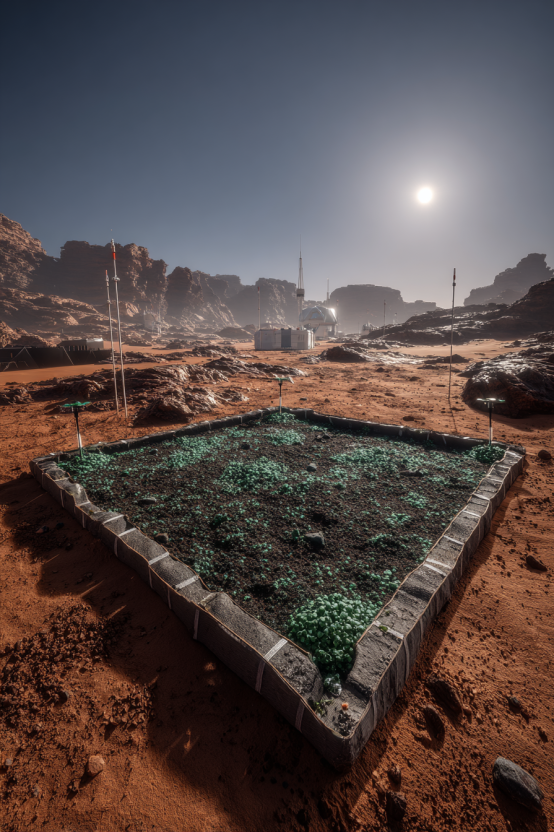
The test zones described in this paper are small on purpose. Each zone is a bounded patch of surface, typically ten to one hundred square meters, adjacent to existing human infrastructure where continuous monitoring is possible. The zones are not farms. They are not parks. They are experiments conducted at the scale of the surface itself, under conditions that cannot be replicated indoors. The design philosophy is simple: contain the experiment so that failure teaches rather than destroys. A perchlorate-reducing colony that thrives in greenhouse regolith might die within hours under full Martian UV. That information is valuable. A cyanobacterial biocrust that builds soil structure indoors might desiccate irreversibly in the low-humidity outdoor environment. That information is also valuable. What would not be valuable is discovering these failures after committing large areas of surface to biological activity that cannot sustain itself. The governing principle of Stage 6 is therefore: you do not scale what you have not proven.
1.3 Scope of This Paper
This paper addresses the full chain of challenges involved in moving biology from greenhouse to surface. Section 2 details the hazards that Martian soil presents to organisms outdoors — not just perchlorates, but the reactive chemistry of iron-oxide-rich regolith under UV irradiation, the production of superoxides and hydroxyl radicals at mineral surfaces, the mobilization of heavy metals in the presence of water, and the chronic ionizing radiation environment. Section 3 reviews the organisms and remediation strategies that greenhouse research has identified as candidates for outdoor deployment. Section 4 describes the physical design of the test zones themselves — site selection, boundary systems, instrumentation, and the staged protocol by which organisms are introduced. Section 5 addresses the monitoring architecture, defining what is measured, how often, and what constitutes success or failure. Section 6 discusses continuity with prior and ongoing stages. Section 7 establishes the criteria for declaring a zone ready to inform Stage 7’s expansion. Throughout, this paper treats the test zones as what they are: the most consequential experiments in the history of biology outside Earth.
2. The Hazards of Martian Soil in the Open Environment
2.1 Perchlorates: The Primary Chemical Barrier
Perchlorate salts — primarily magnesium perchlorate (Mg(ClO₄)₂) and calcium perchlorate (Ca(ClO₄)₂) — are present throughout Martian regolith at concentrations of 0.4 to 0.6 percent by weight, as measured by the Phoenix lander, the Curiosity rover at Gale Crater, and inferred globally from Mars Odyssey’s Gamma Ray Spectrometer. These concentrations are orders of magnitude higher than any natural terrestrial environment. On Earth, perchlorate contamination at parts-per-billion levels triggers regulatory concern. On Mars, the soil contains parts-per-thousand. Perchlorates are toxic to humans because they interfere with iodine uptake in the thyroid gland, and they are toxic to most terrestrial plants and soil microorganisms at Martian concentrations. Any soil that will support outdoor biology must have its perchlorate concentration reduced to levels compatible with the organisms being introduced — and this reduction must be achieved not once, in a controlled greenhouse, but in open regolith exposed to the full Martian environment.
The biochemistry of perchlorate reduction is well understood from terrestrial remediation. Dissimilatory perchlorate-reducing bacteria (DPRB) use perchlorate as a terminal electron acceptor in anaerobic respiration, reducing it through a stepwise pathway: perchlorate (ClO₄⁻) to chlorate (ClO₃⁻) to chlorite (ClO₂⁻), which is then dismutated by chlorite dismutase into chloride (Cl⁻) and molecular oxygen (O₂). The key organisms include Azospira oryzae, which has been tested directly in Mars Global Simulant (MGS-1) regolith amended with perchlorate at Martian concentrations (Bernhardt, 2025), and Dechloromonas agitata, one of the earliest characterized DPRB. Azospirillum species isolated from perchlorate-contaminated environments have demonstrated reduction of ammonium, sodium, and magnesium perchlorates across multiple salt types. The 2025 Cornell iGEM project engineered Escherichia coli to express the perchlorate reductase (pcr) complex — specifically the pcrA, pcrB, pcrC, and pcrD subunits — as a synthetic biology approach to creating purpose-built remediation organisms. These organisms work indoors. Whether they can survive and function in the open Martian environment is the question Stage 6 is designed to answer.
2.2 Reactive Oxygen Species and Iron Photochemistry
Perchlorate is the most discussed soil hazard, but it is not the only one. Martian regolith is rich in iron oxides — hematite (Fe₂O₃), goethite (FeO(OH)), and magnetite (Fe₃O₄) — which give the planet its red color and its chemical hostility. When UV radiation strikes these mineral surfaces in the presence of even trace amounts of water, a cascade of photochemical reactions produces reactive oxygen species (ROS): superoxide anions (O₂⁻•), hydroxyl radicals (•OH), and hydrogen peroxide (H₂O₂). These species are potent oxidizers that degrade organic molecules on contact. Hurowitz et al. demonstrated that basaltic surfaces can generate measurable hydrogen peroxide from reaction with minor amounts of water even without UV irradiation. Under UV illumination, the iron oxide minerals in Martian soil act as photocatalysts, driving the decarboxylation and destruction of amino acids, peptides, and carboxylic acids through Fenton-type chemistry and the photo-Kolbe reaction. The surface of Mars is, in photochemical terms, an oxidizing engine powered by sunlight.
Inside a greenhouse, UV filtering eliminates this problem. Outdoors, organisms introduced to remediated soil still face a mineral substrate that generates oxidants whenever sunlight reaches its surface. The strategy for managing this in Stage 6 is biological rather than chemical: organisms selected for outdoor deployment include those that produce extracellular polysaccharide (EPS) matrices, UV-screening pigments such as scytonemin, and protective biofilm architectures in which surface-layer cells shield interior cells from radiation damage. The logic is borrowed from nature: on Earth, biological soil crusts in the Atacama Desert and Antarctic dry valleys face analogous (if less extreme) oxidative stress and survive through precisely these mechanisms.
2.3 Ultraviolet Radiation
The Martian atmosphere provides minimal UV shielding. Without a significant ozone layer and with atmospheric pressure less than one percent of Earth’s, the surface receives the full UV spectrum from approximately 190 nanometers (where CO₂ absorption cuts off transmission) through UVA. Measurements from the Rover Environmental Monitoring Station (REMS) aboard Curiosity, reported in PNAS in 2025, represent the first direct UV dose measurements from the surface of another planet. They show that the atmosphere attenuates only about 23 percent of incoming UV on average — roughly 21 percent in UVA, 25 percent in UVB, and 34 percent in UVC. Theoretical calculations show that DNA damage rates from solar radiation on the Martian surface are approximately 900 times greater than on the surface of Earth. The total UV fluence rate in the 200 to 400 nanometer range for equatorial Mars under clear skies has been modeled at 42 to 55 watts per square meter, with UVC comprising roughly 8 to 10 percent of that flux. On Earth, UVC never reaches the surface. On Mars, it is a constant presence during daylight.
This UV environment is lethal to most unprotected organisms within minutes to hours of exposure. However, it is not uniformly lethal. The desert cyanobacterium Chroococcidiopsis sp. CCMEE 010, tested in Mars simulation chambers in 2025, maintained photosynthetic activity under simulated Martian UV for up to eight hours when grown under far-red light conditions, with top-layer biofilm cells shielding bottom-layer cells from radiation damage. In the BIOMEX experiment aboard the International Space Station, strains of Chroococcidiopsis survived exposure to space vacuum and full solar radiation for over 1.5 years. Metabolically active lichens, particularly Diploschistes muscorum, have been shown to withstand X-ray doses equivalent to one year of Mars surface exposure during strong solar activity while maintaining active fungal metabolism. These findings do not mean outdoor survival is guaranteed — they mean it is not categorically impossible, and that specific organisms with specific protective adaptations are candidates for Stage 6 deployment.
2.4 Cosmic Radiation and Ionizing Dose
Beyond UV, the Martian surface receives a chronic flux of galactic cosmic rays (GCR) and episodic solar energetic particle (SEP) events. Curiosity’s Radiation Assessment Detector (RAD) measured a GCR dose rate of approximately 210 microgray per day on the Martian surface, yielding roughly 0.077 gray per year. This is approximately 30 times the average background radiation on Earth’s surface. During solar particle events, acute dose spikes can add 25 percent or more to the daily rate. The thin Martian atmosphere provides limited shielding: the mass of atmosphere above any surface point on Mars provides approximately 1.6 percent of Earth’s atmospheric protection at current pressure. Importantly, Mars’s lower gravity means that for a given surface pressure, more air mass sits above you than on Earth — if atmospheric pressure were raised to 10 percent of Earth’s, the radiation shielding from the atmosphere alone would be roughly 26 percent of Earth’s. At 50 percent Earth pressure, atmospheric shielding would actually exceed Earth’s at approximately 132 percent. Stage 4’s thickening atmosphere thus provides a direct radiation benefit to Stage 6’s outdoor biology, even at partial completion.
For organisms in the test zones, the relevant question is whether the chronic ionizing dose compromises biological function over the timescales relevant to remediation and soil building. Earth’s natural background is approximately 0.0024 gray per year. Standard crops show developmental impairment at doses of 0.4 to 0.8 gray, particularly from heavy ion exposure. However, many extremophilic microorganisms tolerate far higher doses. Deinococcus radiodurans survives acute doses exceeding 5,000 gray. Chroococcidiopsis survives kilogray-scale ionizing radiation in desiccated states. The organisms selected for Stage 6 are not standard crops — they are extremophiles and radiation-tolerant strains chosen specifically because the open Martian environment demands radiation resistance as a baseline capability.
2.5 Temperature Extremes and Desiccation
Diurnal temperature swings on the Martian surface can exceed 70 kelvin. At equatorial latitudes, daytime surface temperatures may reach 293 kelvin (20°C) while nighttime temperatures plunge below 200 kelvin (−73°C). Even after Stage 4 warming, the amplitude of these swings, though reduced, remains far beyond anything terrestrial mesophilic organisms experience. Combined with atmospheric pressure still well below the water triple point in most locations, this creates a desiccation cycle where any surface moisture freezes at night, potentially sublimes during the day, and organisms must endure repeated freeze-thaw-desiccation cycles that destroy cell membranes and denature proteins in unprotected species. The organisms chosen for outdoor deployment must tolerate anhydrobiosis — the ability to survive essentially complete water loss and resume metabolic activity upon rehydration. Chroococcidiopsis, tardigrades, certain lichens, and desiccation-tolerant moss species all demonstrate this capacity. In the test zones, organisms are not expected to be metabolically active at all times. They are expected to survive dormancy periods and resume function when conditions transiently permit it — much as cryptoendolithic organisms do in the driest terrestrial deserts.
3. From Greenhouse to Surface: Organisms and Strategies
3.1 What the Greenhouses Proved
By the time Stage 6 begins, the greenhouses of Stage 3 have been operating for decades. They have not merely grown plants — they have built a body of knowledge about how terrestrial biology interacts with Martian mineral substrates. Key findings that inform the outdoor test zones include the following. First, alfalfa (Medicago sativa) grows robustly in bare basaltic regolith simulant without added nutrients, and when its dried biomass is mixed back into the regolith, it serves as a biofertilizer that dramatically improves growth of food crops: turnip shoot height increased 190 percent, radish bulb mass increased 311 percent, and lettuce dry weight increased 79 percent compared to untreated simulant (Kasiviswanathan et al., 2022). Second, perchlorate-reducing bacteria including Azospira oryzae successfully reduce perchlorate at Martian concentrations in regolith simulant, converting toxic ClO₄⁻ to harmless Cl⁻ and releasing O₂ as a byproduct — with the microbial biomass left behind providing organic carbon to the otherwise sterile mineral substrate. Third, cyanobacteria grow on Mars regolith simulants and in soluble extracts derived from them, demonstrating that Martian minerals contain sufficient nutrients (phosphorus, sulfur, calcium, iron, potassium, magnesium) to sustain photosynthetic metabolism without terrestrial soil amendments. Fourth, Anabaena sp. PCC 7938 grows under a 96 percent nitrogen / 4 percent CO₂ atmosphere at 100 hectopascal — ten times lower than Earth’s pressure — on Mars Global Simulant, demonstrating that cyanobacterial growth does not require Earth-like atmospheric conditions. These four findings together establish that the biological foundation for outdoor remediation exists.
3.2 The Perchlorate Remediation Pipeline
Perchlorate removal is the prerequisite for every other biological activity in the test zones. The remediation pipeline developed in the greenhouses follows a defined sequence. The first step is water delivery: perchlorate-reducing bacteria require liquid water and an electron donor (typically acetate or another simple organic compound) to carry out dissimilatory reduction. In the test zones, water comes from Stage 5’s liberation — meltwater piped from nearby extraction points or collected from local surface pooling. The second step is inoculation: slurries of greenhouse-cultured DPRB are mixed into the target soil volume. In greenhouse trials, Azospira oryzae achieved measurable perchlorate reduction within days under optimal conditions. The third step is verification: soil samples are assayed for perchlorate concentration and chloride production to confirm that the reduction pathway is proceeding. Outdoors, this pipeline faces new challenges. UV radiation may kill surface-layer bacteria before they can establish. Temperature cycling may interrupt metabolic activity. Low atmospheric pressure may limit water availability. Stage 6 tests this pipeline under these exact conditions, at small scale, with full instrumentation.
3.3 Phytoremediation as a Secondary Strategy
In addition to microbial perchlorate reduction, certain plant species accumulate and degrade perchlorate through phytoremediation. Three mechanisms are relevant: phytoaccumulation (uptake and storage of perchlorate in leaves and branches), phytodegradation (enzymatic breakdown of accumulated perchlorate within plant tissues), and rhizodegradation (breakdown of perchlorate in the root zone by rhizosphere microorganisms stimulated by root exudates). Woody species are of particular interest because they employ all three mechanisms simultaneously. In the greenhouse context, phytoremediation has been demonstrated as effective for perchlorate removal from terrestrial soils at both bench and pilot scale. For the outdoor test zones, phytoremediation is a secondary strategy — it requires that soil conditions already be partially improved by microbial action before plants can establish. The sequence is microbial remediation first, then biocrust formation to stabilize and build organic content, then phytoremediation-capable plants to continue the cleanup and begin building a more complex soil ecosystem.
3.4 Cyanobacteria: The Pioneer Organisms
Cyanobacteria are the leading candidates for the first organisms deployed to the outdoor test zones. This is not arbitrary. Cyanobacteria are the only prokaryotes capable of oxygenic photosynthesis. They fix both atmospheric carbon and nitrogen, converting CO₂ and N₂ into organic matter and bioavailable nitrogen. They secrete extracellular polysaccharides (EPS) that physically bind soil particles, increase water retention, and create the structural foundation of biological soil crusts. On Earth, cyanobacterial biocrusts are the primary mechanism by which barren mineral substrates are transformed into soil capable of supporting higher plants — the process takes five to ten years in favorable conditions, longer in harsh environments. On Mars, cyanobacteria would serve the same foundational role: converting dead regolith into something approaching living soil.
Several genera are under active investigation for Mars applications. Chroococcidiopsis, isolated from endolithic habitats in the Negev Desert and Antarctic dry valleys, combines extreme desiccation tolerance with resistance to UV and ionizing radiation. Its protective arsenal includes the production of scytonemin (a UV-screening pigment), mycosporine-like amino acids (MAAs), and thick EPS matrices, along with a high capacity for anhydrobiosis. Chroococcidiopsis has been shown to tolerate perchlorate concentrations relevant to Martian soil (Billi et al., 2021) and to survive 1.5 years of space exposure in the BIOMEX experiment aboard the International Space Station. Anabaena cylindrica and Desmonostoc muscorum, filamentous nitrogen-fixing cyanobacteria, grew successfully on MGS-1 and MMS-2 Mars regolith simulants and survived combined desiccation and UV-B radiation stress when associated with clay minerals such as montmorillonite and nontronite. These clays, which are present in Martian soil, appear to offer physical shielding that enhances cyanobacterial survival.
3.5 Microbial Co-cultures and Synthetic Lichens
No single organism can perform all the functions needed for soil remediation. Recent research has focused on cooperative microbial systems — co-cultures in which different species provide complementary metabolic and structural functions. A particularly promising approach is the synthetic lichen system developed for Martian construction applications, in which diazotrophic cyanobacteria fix CO₂ and N₂ from the atmosphere, converting them into organic nutrients and O₂, while filamentous fungi bind metal ions onto cell walls, serve as nucleation sites for biomineral production, and enhance cyanobacterial growth by providing water, minerals, and CO₂. Both components secrete biopolymers that bind regolith particles into consolidated structures. The system grows autonomously using only regolith, air, light, and minimal inorganic medium. In 2025, the Sporosarcina pasteurii / Chroococcidiopsis co-culture system demonstrated that Chroococcidiopsis releases oxygen to support the aerobic partner while its EPS shields Sporosarcina from UV radiation. In return, Sporosarcina drives biocementation that physically stabilizes the regolith. These co-culture systems represent the kind of multi-organism approach that the outdoor test zones are designed to evaluate under real conditions.
4. Test Zone Design and Architecture
4.1 Site Selection
The controlled outdoor test zones are sited adjacent to existing human settlements established during Stage 3. Site selection is driven by three criteria. First, proximity to infrastructure: the zones must be close enough to pressurized habitats that monitoring equipment can be hardwired rather than dependent on remote telemetry, that researchers can inspect the zones during routine EVA, and that water and inoculant can be delivered from greenhouse stocks without long-distance transport. Second, favorable microclimate: within the areas accessible from each settlement, zones are placed in locations that maximize daytime temperature, minimize wind exposure, and take advantage of any natural windbreaks or thermal mass provided by local topography. South-facing slopes in the northern hemisphere and north-facing slopes in the southern hemisphere receive more concentrated solar energy per unit area. Low-lying locations benefit from slightly higher atmospheric pressure. Locations adjacent to Stage 5 water sources allow gravity-fed irrigation. Third, representative regolith: the soil in each zone must be characteristic of the broader regional regolith composition so that results are generalizable rather than artifacts of an unusual local chemistry.
4.2 Zone Dimensions and Boundary Systems
Each test zone covers ten to one hundred square meters. The zone is bounded by a physical perimeter — not a sealed enclosure (that would be a greenhouse) but a low barrier, typically a regolith berm or anchored composite border, that defines the experimental area and prevents uncontrolled migration of remediated soil, water, or biological material beyond the zone boundary. The boundary is not airtight. The zone breathes the same atmosphere as the rest of Mars. It receives the same UV flux, the same cosmic ray dose, and the same temperature swings. What distinguishes it from the surrounding surface is that its soil has been prepared: perchlorates have been reduced through microbial treatment delivered from greenhouse cultures, organic carbon has been added through incorporation of greenhouse-grown biomass (composted plant material, dried cyanobacterial crusts), and water has been delivered to bring the soil to a moisture content compatible with biological activity. The zone is a prepared patch in an otherwise unprepared landscape.
4.3 Staged Introduction Protocol
Organisms are not introduced to the zones all at once. The protocol follows a defined sequence that mirrors the ecological succession observed in terrestrial primary succession — the colonization of bare rock or mineral substrate by biology. The first phase introduces perchlorate-reducing bacteria in a liquid inoculant mixed into the upper regolith. This phase runs for weeks to months, with soil sampling confirming perchlorate reduction before the second phase begins. The second phase introduces cyanobacteria — desiccation-tolerant, UV-resistant strains selected from greenhouse populations — onto the partially remediated surface. The goal is biocrust formation: the development of a living surface layer that fixes carbon and nitrogen, produces EPS, and begins building the organic fraction of the soil. The third phase, contingent on successful biocrust establishment, introduces more complex organisms: mosses, lichens, and eventually small vascular plants such as the alfalfa that proved so effective as a biofertilizer in greenhouse trials. Each phase advances only when monitoring confirms that the previous phase has achieved defined benchmarks.
4.4 Water Management
Water is the limiting resource in every outdoor test zone. Martian surface conditions, even after Stage 4 warming and Stage 5 water liberation, do not guarantee persistent liquid water at any given location. The test zones address this through active water management: piped delivery from Stage 5 extraction points, timed irrigation schedules calibrated to deliver water during the warmest part of the sol when liquid stability is greatest, and soil amendments (composted organic matter, potentially hydrogel polymers) that increase water retention in the otherwise non-absorbent basaltic regolith. Terrestrial experiments have shown that hydrogel addition to Mars simulant soil increased radish germination from near-zero to approximately 27 percent. In the test zones, the goal is not to flood the soil but to maintain sufficient moisture for microbial metabolic activity during the daily window when temperature and pressure permit liquid water to exist. The zones are, in effect, irrigated experiments in a desert that makes the Atacama look wet.
5. Monitoring Architecture
5.1 What Is Measured
Each test zone is instrumented to measure the variables that determine whether biology is surviving, functioning, or failing in the open environment. Soil chemistry monitoring tracks perchlorate concentration (declining values indicate successful remediation), chloride concentration (rising values confirm the reduction pathway), organic carbon content (rising values indicate biological activity is adding carbon to the soil), pH, and heavy metal concentrations (particularly chromium, nickel, and cobalt mobilized from basaltic minerals by water contact). Atmospheric monitoring at the zone boundary measures O₂ concentration in the near-surface air (any measurable increase above ambient indicates photosynthetic activity), CO₂ drawdown, humidity, and temperature profiles. Biological monitoring uses visual imaging (automated cameras recording the zone surface at regular intervals to track biocrust development, color changes, and organism coverage area), fluorescence measurements (chlorophyll fluorescence as a proxy for photosynthetic activity), and periodic soil sampling for microscopic examination, DNA extraction, and metagenomic analysis of microbial community composition. Radiation monitoring records the cumulative UV and ionizing dose received by the zone surface.
5.2 Monitoring Frequency and Automation
Many measurements are automated and continuous. Temperature, humidity, UV flux, and atmospheric composition are logged by instrument packages stationed at each zone perimeter. Soil chemistry requires physical sampling and laboratory analysis — initially performed by EVA crews on a weekly cadence, shifting to biweekly or monthly as the zone matures. Imaging is continuous during daylight hours. Fluorescence measurements are taken daily at the same local solar time to allow meaningful comparisons across sols. The monitoring system is designed to detect both gradual trends (the slow accumulation of organic carbon over months) and acute events (a sudden drop in fluorescence after a solar particle event, indicating radiation damage to photosynthetic organisms). All data feeds into the settlement’s central database, where it is accessible to both on-site researchers and Earth-based science teams — with the caveat that the 4-to-24-minute one-way light delay means real-time intervention is impossible. The zones must be designed so that no single acute event requires immediate human response to prevent catastrophic data loss.
5.3 Defining Success and Failure
A test zone is not declared successful because organisms survive. Survival alone is insufficient. Success requires demonstrated function: perchlorate reduction proceeding at rates consistent with greenhouse benchmarks (allowing for expected rate reductions from UV and temperature stress), cyanobacterial biocrust establishing visible surface coverage that persists through multiple diurnal cycles and seasonal variations, organic carbon content of the soil measurably increasing over time, and soil physical structure improving (increased water retention, particle aggregation from EPS binding). A zone is declared failed if perchlorate concentrations stop declining and remain above safe thresholds, if no biocrust establishes despite repeated inoculation, if organic carbon content does not increase or decreases, or if introduced organisms die without establishing self-sustaining populations. Failure of a single zone does not end Stage 6. It provides data for redesigning subsequent zones — different organism selections, different soil preparation protocols, different irrigation schedules, different site characteristics. The entire purpose of small-scale testing is that failure is affordable.
6. The Atmospheric Shield
Stage 6 does not operate in isolation from Stage 4. The atmospheric engineering described in the Stage 4 white paper continues throughout Stage 6, and its ongoing progress directly benefits the outdoor test zones in ways that compound over time. As atmospheric pressure increases, the mass of gas above the surface provides progressively more shielding against both UV and ionizing radiation. At current Mars pressure (approximately 6 millibars), the atmosphere attenuates only about 23 percent of UV and provides approximately 1.6 percent of Earth’s cosmic ray shielding. But due to Mars’s lower gravity, the relationship between pressure and shielding is more favorable than on Earth: each hectopascal of pressure corresponds to more atmospheric mass overhead. If Stage 4 achieves 60 millibars of surface pressure — a tenfold increase from current conditions — the atmospheric UV attenuation roughly doubles and the cosmic ray shielding reaches approximately 26 percent of Earth’s. If pressure reaches 300 millibars (roughly 30 percent of Earth’s sea-level pressure), atmospheric shielding would approach or exceed 100 percent of Earth’s protection from cosmic rays, and UV attenuation would be dramatically increased, particularly if ozone begins to accumulate from photodissociation of CO₂ and H₂O in the upper atmosphere.
This means that the outdoor test zones established during Stage 6 will operate in a progressively more benign radiation environment as Stage 4 continues its work. Organisms that barely survive under early Stage 6 conditions may thrive under the same conditions a decade later, simply because the sky above them has grown thicker. This is not a design flaw — it is the intended synergy between stages. Stage 4 builds the shield. Stage 6 tests biology beneath it. Each informs the other: if the test zones reveal that UV is the primary killer of outdoor organisms, that information can prioritize atmospheric strategies that increase UV attenuation (such as encouraging ozone formation). If ionizing radiation is the bottleneck, that points toward strategies that increase total atmospheric mass. The stages are not sequential in the sense that one finishes before the next begins. They are concurrent, interactive, and mutually reinforcing.
7. Continuity
7.1 Stage 1 Instruments Continue Monitoring
The robotic instruments deployed during Stage 1’s reconnaissance phase continue operating throughout Stage 6, providing orbital and surface data on atmospheric composition, surface temperature, ice distribution, and radiation environment. This data provides the regional and global context within which the test zone results are interpreted. A test zone showing successful biocrust establishment can be correlated with specific atmospheric pressure, temperature, and UV dose values measured by Stage 1 instruments, producing the empirical relationships that will guide Stage 7’s expansion to new locations.
7.2 Stage 3 Greenhouses Continue Operating
The greenhouses do not close when the test zones open. They continue their three essential functions: producing food for the human settlement, serving as biological research laboratories where new organism combinations and remediation protocols are developed and tested before outdoor deployment, and maintaining genetic stock of the organisms being used outdoors. If an outdoor population fails, the greenhouse provides the reservoir from which it can be re-cultured and reintroduced. The greenhouse is the backup, the nursery, and the control experiment against which outdoor results are compared.
7.3 Stage 4 Atmospheric Engineering Continues
As described in Section 6, Stage 4’s warming and atmospheric thickening are ongoing. Every increment of pressure and temperature makes the outdoor test zones more hospitable. The relationship is direct: more atmosphere means more UV shielding, higher boiling point for water, longer daily windows of liquid water stability, reduced amplitude of temperature swings, and increased partial pressure of CO₂ available for photosynthesis. Stage 4 is not finished. It is the engine that is slowly making Stage 6 easier.
7.4 Stage 5 Water Liberation Continues
Water extraction and surface water formation continue and expand throughout Stage 6. As more ice melts and more extraction infrastructure is deployed, the water available for test zone irrigation increases. Early test zones may be limited by water supply, requiring strict rationing and optimized delivery schedules. Later zones, established as Stage 5 matures, may benefit from more abundant water, enabling larger zones, wetter soils, and more ambitious biological introductions. The arc from early to late Stage 6 tracks the arc of water availability from Stage 5.
8. Criteria for Informing Stage 7
Stage 7 of this framework describes the expansion of biological activity beyond the bounded test zones — the transition from contained experiments to managed open-air ecosystems. Stage 6’s purpose is to generate the data that makes that transition responsible. A test zone qualifies to inform Stage 7 expansion when it meets all of the following criteria. First, perchlorate remediation has reduced soil perchlorate concentration to below the threshold established in greenhouse research as compatible with target organisms — not to zero, but to levels at which the next ecological succession stage (biocrust formation, and eventually plant establishment) can proceed. Second, a biocrust has established, persisted through at least two full Martian years (approximately four Earth years), and demonstrated self-sustaining photosynthetic activity without continuous human intervention beyond irrigation. Third, soil organic carbon content has measurably increased from its initial post-remediation level, indicating that biological activity is building soil rather than merely surviving in it. Fourth, the zone has weathered at least one major solar particle event and at least one Martian dust storm season without total biological collapse — partial setbacks followed by recovery are acceptable and expected. Fifth, the monitoring data is of sufficient quality and completeness to support predictive modeling of how similar biological systems would perform at other locations on Mars.
When these criteria are met, the zone has proven that biology can function on the open Martian surface in a specific location under specific conditions. That proof, replicated across multiple zones with different site characteristics and organism selections, provides the empirical foundation for Stage 7’s managed expansion. Until these criteria are met, expansion does not proceed. The principle remains: you do not scale what you have not proven.
9. Discussion
Stage 6 is where the Mars Habitat Project meets the actual planet. Everything before this point has been either remote (Stage 1), structural (Stage 2), enclosed (Stage 3), atmospheric (Stage 4), or geological (Stage 5). Stage 6 is the first time living organisms are asked to survive and function on the open Martian surface, under conditions that have not supported biology for approximately three billion years. The honesty required here is considerable. The Martian surface is hostile to life in multiple simultaneous ways: chemical toxicity from perchlorates and ROS, sterilizing UV radiation, chronic ionizing radiation, extreme temperature cycling, and desiccation. No single adaptation overcomes all of these. The organisms chosen for outdoor deployment must resist UV, tolerate perchlorate, survive desiccation, remain functional under ionizing radiation, and metabolize in temperature ranges that freeze most terrestrial biology. Such organisms exist — Chroococcidiopsis, certain lichens, selected extremophilic bacteria — but their survival in laboratory Mars simulations does not guarantee performance in the real environment, where all stressors act simultaneously and indefinitely.
The test zone architecture described in this paper is designed to manage this uncertainty. By keeping zones small, bounded, and heavily instrumented, the project ensures that both successes and failures generate usable data. By following a staged introduction protocol that mirrors ecological succession — microbial remediation first, then biocrust, then higher organisms — the project respects the biological reality that complex ecosystems are built from the bottom up, not imposed from the top down. By maintaining continuity with greenhouse operations, the project preserves fallback positions and control comparisons. And by requiring demonstrated function over multi-year timescales before allowing expansion, the project guards against the temptation to declare premature victory.
The scientific foundation for Stage 6 is real. Perchlorate-reducing bacteria work in regolith simulant. Cyanobacteria grow on Martian minerals. Extremophilic organisms survive Mars-like radiation, pressure, and desiccation in laboratory simulations. Alfalfa turns dead basalt into soil that grows food. Microbial co-cultures build structural material from regolith and air. None of this has been done outdoors on Mars. That is precisely what Stage 6 is for.
10. Conclusion
Stage 6 of the Mars Habitat Project establishes controlled outdoor test zones — small, bounded, heavily monitored patches of Martian surface where biology that was proven inside the greenhouse is tested against the reality of the open planet. The soil in these zones has been remediated through microbial perchlorate reduction developed over decades of enclosed research. The organisms introduced are not random selections but specifically chosen for their demonstrated tolerance to the hazards of the Martian surface: UV radiation, ionizing radiation, desiccation, temperature extremes, and the reactive photochemistry of iron-oxide-rich regolith. The zones are small because failure must be survivable. The protocol is staged because ecosystems build from the bottom up. The monitoring is comprehensive because every data point — success or failure — informs what comes next.
The question Stage 6 answers is not whether Mars can support life in a greenhouse. That was answered in Stage 3. The question is whether Mars can support life on its surface — under its sky, in its soil, at its temperatures, beneath its radiation — once that surface has been minimally prepared and the atmosphere has been partially thickened by the work of prior stages. If the answer is yes, even for a few hardy organisms in a few prepared patches, then Stage 7’s expansion has an empirical foundation rather than a theoretical hope. If the answer is no, then the project knows where the bottleneck lies and can direct resources accordingly — thicker atmosphere, better UV shielding, different organism engineering, alternative remediation chemistry. Either outcome advances the program. Only ignorance stalls it.
The test zones are the smallest, most cautious, most carefully controlled biological experiments ever conducted on another world. They are also potentially the most consequential. If a cyanobacterial crust can establish itself on open Martian regolith and persist through Martian seasons, it will be the first self-sustaining biology on the surface of another planet in the history of life. That outcome is not certain. But the greenhouse data says it is possible, and the only way to know whether possibility becomes reality is to open the door and let biology meet Mars.
References
Bernhardt, B. (2025). Biological Reduction of Perchlorate in Martian Regolith Simulant Using Azospira oryzae. Undergraduate Honors Thesis, University of Nebraska-Lincoln.
Billi, D. et al. (2021). Exploiting a perchlorate-tolerant desert cyanobacterium to support bacterial growth for in situ resource utilization on Mars. International Journal of Astrobiology, 20, 29–35.
Cockell, C.S. et al. (2005). Effects of a simulated martian UV flux on the cyanobacterium, Chroococcidiopsis sp. 029. Astrobiology, 5(2), 127–140.
Cornell iGEM (2025). Microbial co-culture system for Martian regolith remediation: Engineering E. coli perchlorate reductase expression. iGEM 2025 project.
Hassler, D.M. et al. (2014). Mars’s surface radiation environment measured with the Mars Science Laboratory’s Curiosity rover. Science, 343(6169).
Kasiviswanathan, P. et al. (2022). Farming on Mars: Treatment of basaltic regolith soil and briny water simulants sustains plant growth. PLoS ONE, 17(8), e0272209.
Khoshtinat, S. et al. (2025). From Earth to Mars: A perspective on exploiting biomineralization for Martian construction. Frontiers in Microbiology, 16.
Jin, C. et al. (2025). Synthetic lichen system for autonomous construction on Mars using regolith. Journal of Manufacturing Science and Engineering.
Macario, I.P.E. et al. (2025). Survival of filamentous cyanobacteria through Martian ISRU: Combined effects of desiccation and UV-B radiation. Microorganisms, 13(5), 1083.
Martinez-Luaces, V. et al. (2025). Ultraviolet and biological effective dose observations at Gale Crater, Mars. PNAS.
Misra, G. et al. (2021). Potential biological remediation strategies for removing perchlorate from Martian regolith. New Space, 9(4).
Rosado, A.S. et al. (2025). The role of extremophile microbiomes in terraforming Mars. Communications Biology, 8, 1588.
Skubała, K. et al. (2025). Ionizing radiation resilience: How metabolically active lichens endure exposure to the simulated Mars atmosphere. IMA Fungus.
Verseux, C. et al. (2021). Sustainable use of Mars resources for cyanobacterium-based life support: Low-pressure, nitrogen-rich atmosphere. Frontiers in Microbiology, 12.
Wamelink, G.W.W. et al. (2014). Can plants grow on Mars and the Moon: A growth experiment on Mars and Moon soil simulants. PLoS ONE, 9(8), e103138.